
SpaceX came public at $135 a share. Two trading sessions later, buyers briefly paid $225.64. By July 17, they were paying $123.99.
That sequence is easy to describe as a broken IPO. It is more useful to see it as three different prices for three different things. The offering price valued a mature launch monopoly, a fast-growing global communications network, and a newly combined AI business. The first-week high also priced scarcity and public fascination. The subsequent decline began to price execution, dilution, and the amount of capital required to turn several extraordinary engineering programs into ordinary cash flows.
The decline does not say that reusable launch has lost its strategic value or that Starlink has stopped growing. It says that a great company can arrive in the public market with too much of its distant future already included in the stock.
That distinction matters for any long-term assessment of SpaceX. The business has a credible route to becoming one of the most important industrial platforms of the next decade. The shares can still disappoint if the route takes longer, costs more, or produces lower returns than the price assumes.
The first month was partly a float experiment
SpaceX's IPO closed on June 15 after the company sold 638.9 million Class A shares at $135 and raised about $85.7 billion before fees. That was the largest capital raise ever completed in a public offering. It was also a relatively narrow opening into a company with more than 13 billion shares outstanding after the deal.
Less than 5 percent of the post-offering share count entered the market through the IPO. Demand, meanwhile, came from institutions, retail buyers, index-linked funds, and investors who had spent years unable to own SpaceX directly. A small tradable float met an unusually large pool of attention. The stock closed its first session at $160.95 and reached an intraday high of $225.64 on June 16, 67 percent above the offering price.
This was not a clean referendum on ten years of expected cash flows. It was a price set at the narrowest point of the supply funnel.
The funnel is already widening. According to the company's SEC disclosures as summarized by Axios, up to 1.37 billion additional shares could become eligible for sale around the first post-IPO earnings release, depending in part on the stock price. That is more than twice the share count sold in the IPO. More employee and investor shares become tradable later.
The prospect of a much larger float does not change the value of Starlink or the probability that Starship works. It changes the clearing price. Early investors and employees may sell for reasons that have little to do with their view of the company, while new buyers no longer need to pay a scarcity premium to obtain a position.
At the July 17 close, the stock was 45 percent below its first-week high and 8 percent below the IPO price. The speed of that reversal looks dramatic. The mechanics behind it are fairly conventional.
Starlink is the present tense
The cleanest way to value SpaceX is to begin with the business that already works at commercial scale.
Starlink had approximately 10.3 million subscribers across 164 markets as of March 31, up from 5 million one year earlier. SpaceX reported 9,600 satellites in orbit, more than 3,000 deployed during 2025, and service coverage reaching more than 3.3 billion people.
The financial results are stronger than the subscriber headline. SpaceX's Connectivity segment generated $11.4 billion of revenue in 2025, up 49.8 percent, and $4.4 billion of operating income, up 120.4 percent. Segment adjusted EBITDA reached $7.2 billion. In the first quarter of 2026, Connectivity produced $3.3 billion of revenue and $1.2 billion of operating income.
Those numbers make Starlink more than an ambitious satellite project. It is a profitable communications platform with a globally distributed physical network, direct ownership of its launch supplier, and a widening set of customer types.
Consumer broadband remains the volume engine. The more durable growth may come from enterprise, aviation, maritime, government, and direct-to-device mobile service. These customers value coverage and resilience more than the cheapest monthly connection. They also expand the addressable market beyond households that lack fiber or cable.
There is an important qualification. Subscriber growth in the first quarter was partly offset by a 22.9 percent decline in average revenue per user as Starlink expanded internationally and introduced lower-priced plans. A network can add users rapidly while the economics of each new user become less attractive. Satellites also have finite lives, so maintenance capital never disappears.
The long-term Starlink case therefore depends on more than subscriber count. Investors should watch service revenue per satellite, capital spending per net addition, enterprise mix, terminal subsidies, and the cost of replacing each generation of the constellation. The moat is real. The return on the next dollar invested still has to be measured.
Launch is the moat, even when it is not the profit center
SpaceX says it has carried more than 80 percent of the world's mass to orbit since 2023. More than 95 percent of its 2025 missions used at least one reflown booster. Falcon 9 has turned reuse from a demonstration into a production system.
That position matters in two ways. Third-party launches produce revenue from commercial operators, NASA, and national-security customers. More important, low-cost internal launches let SpaceX build Starlink at a cadence that would be difficult to purchase from someone else. The launch business and the satellite network are complements, not separate bets.
The reported Space segment can look weaker than the strategic position. It generated $4.1 billion of revenue in 2025 and recorded a $657 million operating loss, after funding $3.0 billion of Starship research and development. The segment returned to an adjusted EBITDA loss in the first quarter of 2026 as Starship and launch-site investment accelerated.
Those losses may be rational. SpaceX is using a proven vehicle to finance the development of the vehicle intended to replace it. But investors should resist the habit of relabeling every expense as optional investment. Starship is not just another growth project. It is the hinge connecting the current company to much of the valuation.
Starship has to become a transportation system
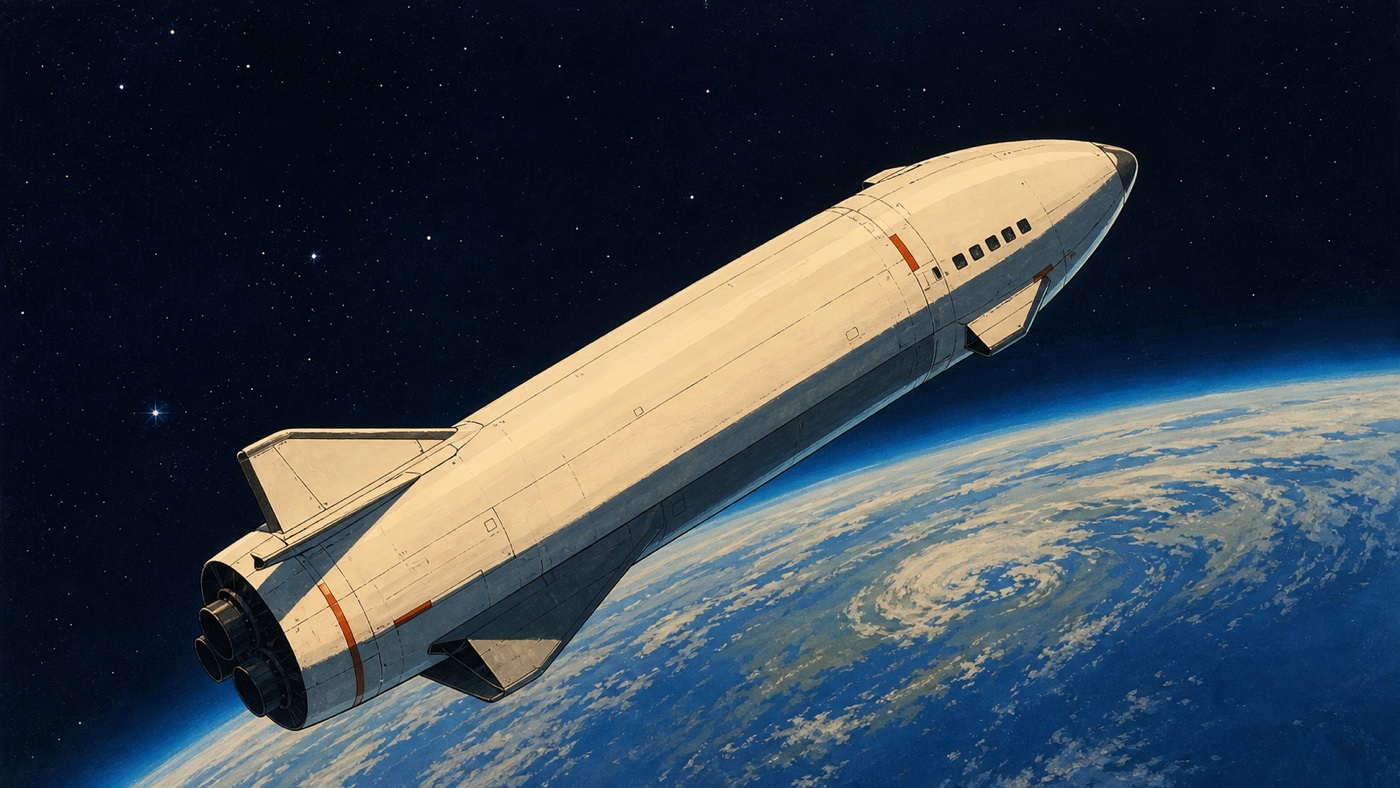
Falcon 9 can keep Starlink competitive and preserve SpaceX's lead in launch. Starship is required for the more expansive case.
The company presents Starship V3 as a fully reusable vehicle capable of carrying roughly 100 metric tons to low Earth orbit, compared with 23 metric tons for Falcon 9. If it reaches high cadence with rapid reuse, SpaceX can deploy larger Starlink satellites, replenish the constellation faster, carry customers that do not fit on Falcon, and begin moving AI compute hardware into orbit.
Payload capacity is not the same as transportation economics. Starship still needs to demonstrate reliable payload delivery, controlled reentry, rapid refurbishment, repeatable booster and ship recovery, and a launch cadence high enough to spread fixed costs. A test vehicle can survive failures that a commercial schedule cannot.
This creates a useful dividing line for the stock. Delays that leave Falcon and Starlink intact reduce the value of the distant opportunities, but they do not destroy the existing business. A repeatable Starship system does the opposite: it reduces the cost of expanding Starlink and opens markets that are currently too expensive to serve.
The first serious valuation upgrade should come from operational evidence, not another rendering of a Mars base. Watch payload delivered per quarter, time between flights, recovery rates, and the cost of refurbishment. These are the numbers that turn a rocket into infrastructure.
AI makes the company larger and the capital problem harder
SpaceX acquired xAI in February 2026, combining launch, Starlink, terrestrial compute, Grok, and X inside one company. The strategic logic is understandable. SpaceX controls distribution through Starlink, xAI creates demand for compute, and the combined group can allocate hardware and capital across terrestrial and eventually orbital systems.
The current financial contribution is not optionality. It is already large and expensive.
The company's prospectus materials show the AI segment producing $3.2 billion of revenue in 2025 while recording a $6.4 billion operating loss and $12.7 billion of capital expenditures. In the first quarter of 2026, AI revenue was $818 million, the operating loss was $2.5 billion, and capital expenditures reached $7.7 billion.
For comparison, total first-quarter revenue across SpaceX was $4.7 billion. Combined capital expenditures for Space, Connectivity, and AI were about $10.1 billion. The AI buildout consumed more than three quarters of that amount.
SpaceX has found at least one major customer for the infrastructure. A June 5 agreement with Google covers access to roughly 110,000 Nvidia GPUs and associated capacity. The customer agreed to pay $920 million per month from October 2026 through June 2029 after a ramp period. The contract can be reduced if SpaceX misses the delivery commitment, and either party can terminate after December 31, 2026 with 90 days' notice.
At its full run rate, that one agreement represents more than $11 billion of annual revenue. It also introduces customer concentration, delivery risk, and the possibility that expensive capacity becomes underutilized if the contract ends early. Investors should treat it as important validation, not guaranteed backlog through 2029.
The near-term AI case does not require computers in space. Ground-based compute can earn revenue, Grok can develop subscription and enterprise demand, X can provide distribution, and Starlink can put AI services in places where fixed networks are weak. If SpaceX can lower its cost per unit of compute while keeping utilization high, AI becomes a second platform business.
If it cannot, AI becomes a claim on the cash generated by Starlink and the capital raised in the IPO.
Orbital compute is credible enough to study and too early to underwrite
SpaceX expects to begin deploying AI compute satellites as early as 2028. Its filing describes a system built around Starship launches, solar power, large radiators, radiation-tolerant processors, and Starlink's existing laser network. The company already operates more than 23,000 inter-satellite laser links and has experience managing thousands of spacecraft as one network.
This is a better starting position than any other AI company has. SpaceX owns the launch vehicle, satellite factory, orbital network, fleet-management software, and an AI workload that could become the first customer.
It is not yet proof of favorable economics.
Space offers abundant solar energy, but power generation requires large arrays. Vacuum removes convective cooling, which means heat must be moved into radiators and rejected through radiation. High-end processors must survive radiation, launch vibration, and repeated thermal cycles. Failed hardware cannot be repaired economically. Training frontier models also requires dense, high-bandwidth communication among accelerators, a problem that free-space laser links have not solved at data-center scale.
Hardware obsolescence creates another mismatch. AI accelerators may become commercially old before a satellite reaches the end of its physical life. SpaceX proposes shifting older hardware to less demanding workloads and deorbiting systems when necessary. That is feasible, but it makes launch and replacement cost part of the depreciation schedule for every token produced.
The first attractive orbital workload is more likely to be inference near the edge of the network than frontier-model training. Remote government users, ships, aircraft, autonomous systems, and regions with weak terrestrial infrastructure may pay for global availability even if the raw compute cost is not the lowest. A commercially useful niche would matter. It does not require the million-satellite vision to arrive on schedule.
Orbital compute should therefore sit in the valuation as a staged option. Give it more weight after a prototype demonstrates useful power density, thermal control, processor reliability, laser bandwidth, and paying demand. Before that, it is a serious engineering program rather than an earnings forecast.
The valuation still assumes an exceptional decade
At $123.99, SpaceX had a market value of roughly $1.62 trillion. The company reported $18.7 billion of 2025 revenue, a $2.6 billion operating loss, and a $4.9 billion net loss. The stock therefore traded at about 87 times trailing revenue even after falling below the IPO price.
The IPO proceeds and preexisting liquidity give SpaceX an unusually strong balance sheet, so a simple market-value-to-revenue comparison is incomplete. It is still useful for understanding the growth burden.
Suppose revenue compounds at 30 percent annually for ten years, an exceptional result for a company already operating at this scale. Revenue would reach about $258 billion in 2035. At a 20 percent operating margin, that would produce roughly $52 billion of operating income. Today's market value is more than 31 times that hypothetical 2035 operating income, before discounting it back ten years and before accounting for future dilution.
This is not a price target. It shows why the stock cannot be justified by Starlink broadband alone. Investors are paying for continued Starlink growth, Starship success, profitable AI infrastructure, new mobile and government markets, and at least some value from businesses that do not yet exist.
A 10 percent annual return from a $1.62 trillion starting value would require a market value above $4.2 trillion in ten years, excluding dividends. That is possible only if SpaceX becomes much more than the world's best launch company.
Three paths from here
The base case is a strong business paired with an uneven stock. Starlink keeps growing, enterprise and mobile improve the mix, Falcon preserves the launch lead, and Starship progresses more slowly than the public roadmap. AI adds revenue but consumes large amounts of capital. Under this path, company value rises over time while the valuation multiple contracts. The stock can spend years growing into its first public price.
The bull case requires several systems to reinforce one another. Starship reaches dependable reuse. Lower launch cost improves Starlink economics and makes larger satellites practical. Direct-to-device and enterprise services expand the revenue pool. Ground AI infrastructure reaches high utilization, and early orbital compute finds premium workloads. In that world, SpaceX owns a rare physical stack across transport, communications, power, compute, and distribution. The current valuation could eventually look less extreme.
The bear case does not require SpaceX to fail. Starlink can remain profitable while subscriber economics weaken. Starship can work but miss its cost or cadence targets. AI revenue can grow while losses and capital spending grow faster. Lockup expirations and equity compensation can expand the tradable supply. Regulatory conflict, spectrum constraints, orbital debris, launch accidents, government dependence, or founder-controlled capital allocation can raise the discount rate. A very good company can lose a large amount of market value under that combination.
The proof points matter more than the next bounce
The stock's first month has produced plenty of price action and little new information about the ten-year business. The next useful evidence will be operational.
For Starlink, watch subscriber growth beside ARPU, enterprise mix, and capital spending. For launch, watch Starship payload delivery, recovery, turnaround, and flight cadence. For AI, watch contracted utilization, segment losses, and the return on a data-center buildout that is already consuming billions each quarter. For the stock, watch how the market absorbs lockup releases and future equity issuance.
The long-term case remains compelling because SpaceX has already done the hard part once. It turned rocket reuse and low-orbit broadband from improbable ideas into operating systems. That history deserves weight. It does not remove the need to distinguish demonstrated capability from projected scale.
SpaceX may become one of the world's most valuable industrial platforms. At $123.99, investors are still paying today for a meaningful share of that outcome. The pullback has removed the first-week frenzy. It has not made the future free.
Sources
This report uses SpaceX filings and investor materials for offering terms, financial results, operating metrics, contracts, and company forecasts. Market prices use daily trading data through July 17, 2026. Company targets for Starship, Terafab, and orbital compute are treated as scenarios until supported by operating evidence.