
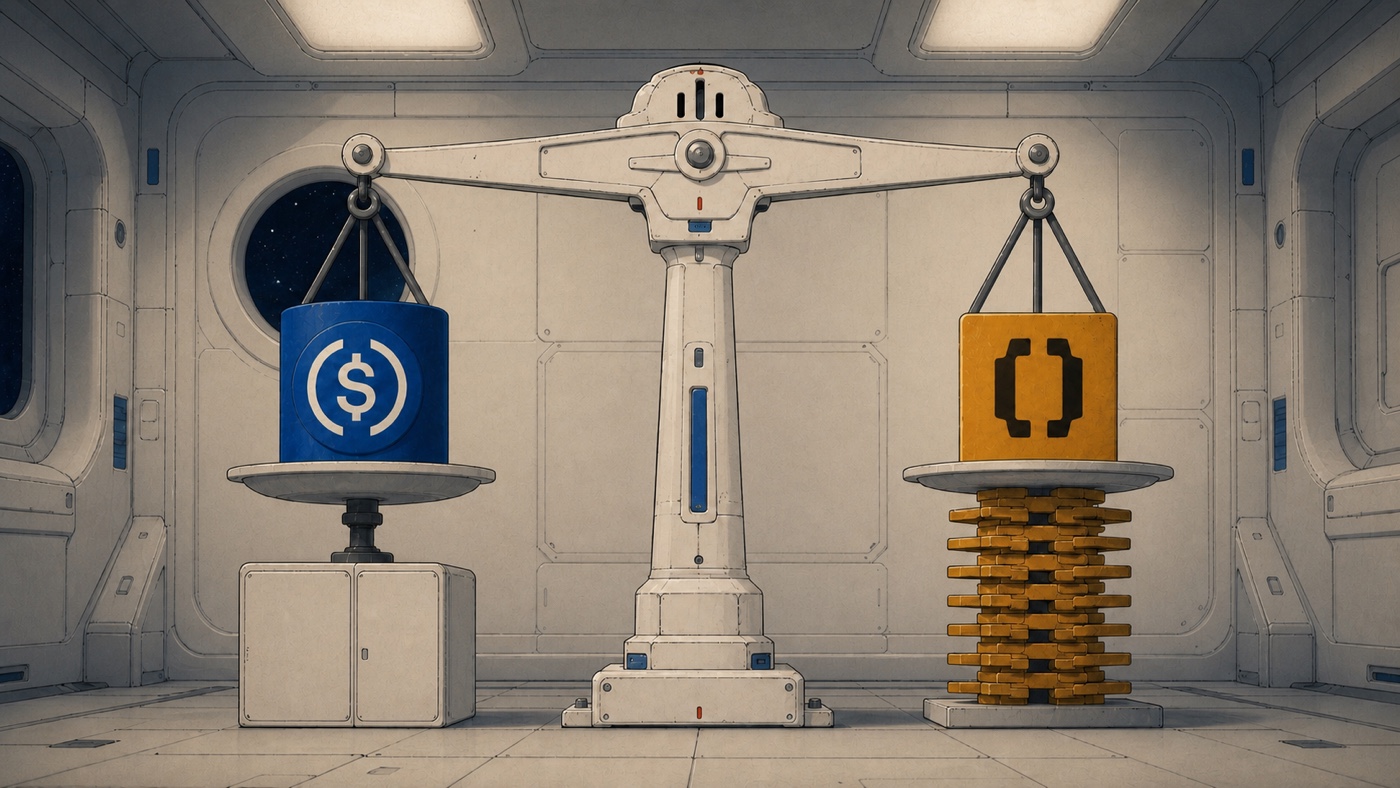
A stablecoin does not become money because 140 companies put their logos on a website. It becomes money when people accept it without thinking about the issuer, when market makers can move size without moving the price, and when developers treat it as infrastructure rather than a product choice.
That distinction is the center of the Open USD debate.
Open Standard has assembled an extraordinary coalition around Open USD, or OUSD. Its membership includes Visa, Mastercard, American Express, Stripe, BlackRock, Coinbase, BNY, Standard Chartered, Google, Shopify, Ripple, Solana, Stellar, and more than 100 other banks, payment companies, exchanges, wallets, and blockchain networks. The project is not another thinly capitalized token trying to buy attention with a high yield. It has credible distribution.
It also has a sharp economic proposition. Open USD says it will return nearly all reserve income, after a small management fee, to the companies that adopt and distribute it. Minting and redemption will have no fees or volume limits. Governance will sit with an independent organization rather than a single issuer.
This is a serious attack on Circle. It is not, however, the same as a credible plan to erase USDC.
The more likely outcome is less dramatic and more consequential for the business behind the coin: Open USD can force Circle to share more of USDC’s economics, defend more distribution channels, and accept lower margins without breaking the network that makes USDC useful.
Open USD attacks the toll booth
Circle’s business looks simple from a distance. Users give Circle dollars, Circle issues USDC, and the reserves earn interest. The token itself does not pay that interest to holders. Circle records the reserve income and then pays a large share of it to the companies that distribute USDC.
The last clause matters. Open USD’s revenue-sharing idea is not completely new. Circle already pays for distribution.
In its 2025 annual report, Circle reported $2.75 billion of total revenue and reserve income, but only $1.08 billion after distribution and transaction costs. Payments to Coinbase are tied mainly to reserve income and USDC balances on and off the exchange. Circle also disclosed growing incentive costs for Binance and other strategic partners.
Open USD turns those negotiated bilateral payments into the organizing principle of the network. Its message to distributors is direct: the reserve pool exists because your customers hold the coin, so most of the economics should follow you.
That pitch is powerful because stablecoin distribution is expensive and concentrated. Wallets, exchanges, payment processors, and fintech applications control the customer relationship. If two regulated dollar tokens are equally safe and equally liquid, the distributor has an obvious reason to prefer the one that pays more.
Open USD therefore does not need to destroy USDC to hurt Circle. It only needs to establish a credible outside option. Every major distributor negotiating a new USDC agreement can point to Open USD and ask for a larger share.
USDC’s moat is accumulated coordination
The case for Open USD is strongest when a stablecoin is described as a simple wrapper around Treasury bills. Under that description, reserves are commodities, smart contracts can be copied, and the lowest-cost issuer should win.
Real stablecoins are not that simple. The backing is the easiest layer to replicate. The hard part is coordinating the many institutions that must treat the same token as cash at the same time.
As of July 16, Circle reported $73.1 billion of USDC in circulation. USDC was natively available on 34 blockchain networks by May, with institutional minting and redemption through Circle Mint. Circle’s Cross-Chain Transfer Protocol allows native USDC to move between supported chains through burn and mint rather than through wrapped tokens and third-party bridge risk. Circle Payments Network adds regulated payment providers, banks, and local payout partners around the asset.
Those integrations create several moats at once.
First, USDC is liquid where institutions and crypto applications already need it. It is collateral in lending markets, a quote asset on exchanges, working capital for market makers, settlement money for fintechs, and a treasury asset for companies that operate across chains. Each use reinforces the others.
Second, USDC has an established redemption and reserve-management system. Most of the reserve sits in the Circle Reserve Fund, an SEC-registered government money market fund managed by BlackRock and custodied at BNY Mellon. Circle publishes monthly third-party assurances, while BlackRock publishes daily fund data. The structure is not risk-free, as USDC’s temporary depeg during the 2023 Silicon Valley Bank failure demonstrated, but it is understood by the market and has survived a real confidence shock.
Third, Circle has spent years obtaining licenses and building compliance operations. Its public license register includes money-transmitter coverage in the United States and regulated entities in France, Singapore, Bermuda, Abu Dhabi, and the United Kingdom. USDC is issued in Europe under Circle’s MiCA-compliant electronic-money framework. A new issuer can follow the same rules, but it cannot compress years of supervisory history into a launch announcement.
Finally, integrations become institutional memory. A bank risk committee that has approved USDC, a treasury team that has written redemption procedures, and a smart contract that has hard-coded USDC as collateral do not switch merely because a new coin offers better economics. Someone must own the migration, test the controls, rebuild liquidity, and accept the operational risk.
This is the part of Circle’s moat that does not appear on the balance sheet.
Open USD can expand quickly, especially outside crypto
None of this makes Open USD harmless.
Its coalition reaches places where USDC is present but not yet native to the customer experience. Stripe can make a settlement asset the default inside a payment workflow. Card networks can place it behind merchant or issuer settlement. Banks can use it for tokenized deposits, treasury transfers, or cross-border payments. Wallets and exchanges can create immediate access for millions of users. Commerce platforms can embed it without asking customers to understand blockchains at all.
The Open Standard proposal is designed for that world. It promises free minting and redemption, regulated reserves, shared governance, technical support, and reserve economics that reward adoption. These features are more useful in embedded payments than in speculative crypto trading, where liquidity and collateral depth usually matter more than the issuer’s revenue-sharing formula.
Open USD may therefore expand through closed or semi-closed loops first. A payment platform can create supply, route transactions among its own merchants and partners, and redeem at the edges. It does not need to displace USDC on every exchange before becoming economically meaningful.
The strongest members also have real operating leverage. Visa reported more than a $3.5 billion annualized run rate for stablecoin settlement before joining Open Standard. Stripe owns Bridge and has helped build Tempo as a payments-led blockchain. Coinbase can place an asset across trading, custody, payments, and wallet products. BlackRock and BNY know how to manage and custody a reserve pool at institutional scale.
If a handful of these companies make Open USD a genuine default rather than an optional integration, supply can grow much faster than most new stablecoins.
A coalition is not a company
The list of partners is Open USD’s best argument and its largest source of uncertainty.
Open Standard says that joining means adopting Open USD as a core transactional asset and earning revenue based on usage. Its public materials do not yet show binding volume commitments, exclusivity terms, the voting power of individual members, or the formula that will divide reserve income among different kinds of contribution. Those details determine whether 140 members behave like a network or a mailing list.
The members also have conflicting incentives.
Visa is an Open Standard member, but it has spent years building USDC settlement. In December 2025, Visa expanded direct USDC settlement to U.S. issuers and acquirers and said it planned to use Circle’s Arc network for USDC settlement. Joining Open Standard gives Visa another rail. It does not erase the first one.
BlackRock appears on the Open Standard list while continuing to manage the Circle Reserve Fund, which held more than $64 billion in June. Coinbase is even more conflicted. Its economics are deeply tied to USDC under a long-running agreement with Circle, and its own 2025 filing describes how it participates in reserve income. Membership in Open Standard improves Coinbase’s optionality and negotiating position whether or not it ever makes Open USD its primary stablecoin.
Other members are building their own currencies. Ripple issues RLUSD. Fiserv promotes FIUSD to banks and merchants. Several banks belong to overlapping regional stablecoin initiatives. Visa, Mastercard, American Express, and Discover are partners in Open Standard, but they remain direct competitors in payments.
These companies can agree that shared infrastructure is useful without agreeing on who controls the customer, which blockchain receives priority, how compliance costs are allocated, or which member deserves the largest share of reserve income.
This does not make the alliance fake. It makes the alliance non-exclusive. Many members are likely purchasing strategic insurance: influence the standard, learn the system, protect access to the economics, and avoid being locked out if Open USD succeeds. That is rational. It is not the same as committing their distribution to one coin.
Revenue sharing has been tried before
Open USD has a useful predecessor. Paxos and the Global Dollar Network built USDG around a similar principle: return reserve economics to the partners that distribute and use the stablecoin.
The network has recruited exchanges, wallets, payment companies, and fintechs. USDG has grown to roughly $3.2 billion in supply, which is meaningful for a young asset. It is still a small fraction of USDC.
The comparison should not be pushed too far. Open Standard’s membership is broader, and Stripe, Visa, Coinbase, BlackRock, and major global banks create a far larger potential distribution surface. Still, USDG demonstrates a basic truth: a better incentive formula can attract partners without instantly creating deep, general-purpose liquidity.
Distribution incentives can seed a network. They cannot substitute for every network effect.
The probable outcome is coexistence with lower tolls
There are three plausible paths.
In the first, Open USD becomes a real but specialized payment asset. Stripe, selected banks, and large platforms use it where revenue sharing makes the economics attractive. USDC remains stronger in crypto liquidity, institutional collateral, multichain treasury, and applications that already depend on it. This is the most likely outcome.
In the second, Open USD becomes a broad default. That requires more than a launch. Coinbase, Stripe, Visa, major exchanges, and market makers would need to seed deep liquidity, make OUSD the default in important products, and accept shared governance in practice. Under this scenario, USDC could lose meaningful market share, and Circle would probably respond by paying distributors more. Circle’s economics would deteriorate before USDC disappeared.
In the third, the coalition underdelivers. Members add OUSD support but route little volume. Governance moves slowly, liquidity fragments across chains, and the reserve-sharing formula becomes a negotiation among companies with very different contributions. Open USD survives, but the logo wall proves larger than the market.
The evidence needed to distinguish these paths is observable. Watch for binding default-placement agreements, not membership announcements. Watch circulating supply without temporary rewards, redemption volumes, exchange depth, use as collateral, and the number of applications that price products in OUSD. Most important, watch whether members remove USDC from prominent flows or simply add another option beside it.
Circle’s moat is deep, but it is not free
USDC should not be treated as invulnerable. Circle depends on partners it does not control, and Open USD gives those partners a well-organized alternative. The coalition can pressure distribution agreements, capture new embedded payment flows, and reduce the share of reserve income that Circle keeps.
But complete displacement is a much higher bar.
USDC already coordinates tens of billions of dollars across exchanges, blockchains, market makers, banks, payment providers, developers, and regulated entities. Open USD begins with impressive names and no operating history. Its members are powerful, but many are hedging, several are competitors, and some are economically attached to USDC or their own stablecoins.
The likely result is not winner-take-all. It is a market in which distribution captures more of the economics and issuers keep less.
Open USD may become the strongest new challenger to Circle’s business model. That does not mean it will defeat USDC. It means USDC’s moat will become more expensive to defend.
Sources
This report distinguishes announced participation from operating adoption. Open USD had not launched by July 20, 2026, so claims about future distribution are treated as scenarios rather than current market share. Supply, reserve, regulatory, and partnership facts use public information available through July 20, 2026.