

AI changes tasks before it changes occupations
AI can perform tasks within a job without replacing the whole occupation. That distinction explains why strong task-level productivity gains can coexist with modest changes in aggregate employment.
A payroll clerk reconciles accounts, answers questions, interprets exceptions, and takes responsibility when the numbers are wrong. A software engineer writes code, but also negotiates requirements, reads old systems, reviews colleagues’ work, and decides which failure matters. A nurse records notes and monitors vital signs; the job still turns on touch, judgment, trust, and physical presence. AI can absorb meaningful pieces of all three jobs without making any of them disappear.
That distinction is why the public debate keeps producing incompatible headlines. One study counts the tasks a model could perform and finds enormous exposure. Another looks for lost jobs in payroll records and finds little. A third detects falling employment among young workers in a narrow set of occupations. Each may be measuring a different stage of the same transition.
The base case is not a sudden, global jobs collapse. It is a long, uneven reorganization of work in which hiring changes before head count, entry-level routes narrow before professions vanish, and the gains accrue first to the firms and workers already equipped to use the technology. Mass unemployment remains a real tail risk if capable autonomous systems become cheap and reliable across both digital and physical work. It is not yet the most likely path.
Exposure is not unemployment
The best global estimates measure exposure: the share of work containing tasks that AI may be able to perform. They do not measure how many people will be fired.
The International Labour Organization’s refined 2025 index assessed nearly 30,000 tasks and concluded that one in four workers worldwide is in an occupation with some degree of generative-AI exposure. The ILO’s more important conclusion was qualitative: because most occupations still require human input, transformation is more likely than redundancy.
The International Monetary Fund uses a broader measure and estimates that almost 40% of global employment is exposed to AI. Its country split is revealing: about 60% in advanced economies, 40% in emerging markets, and 26% in low-income countries. Rich countries look more vulnerable because more people work in digitized, cognitive occupations. They also have the infrastructure, capital, and skills to capture the productivity upside.
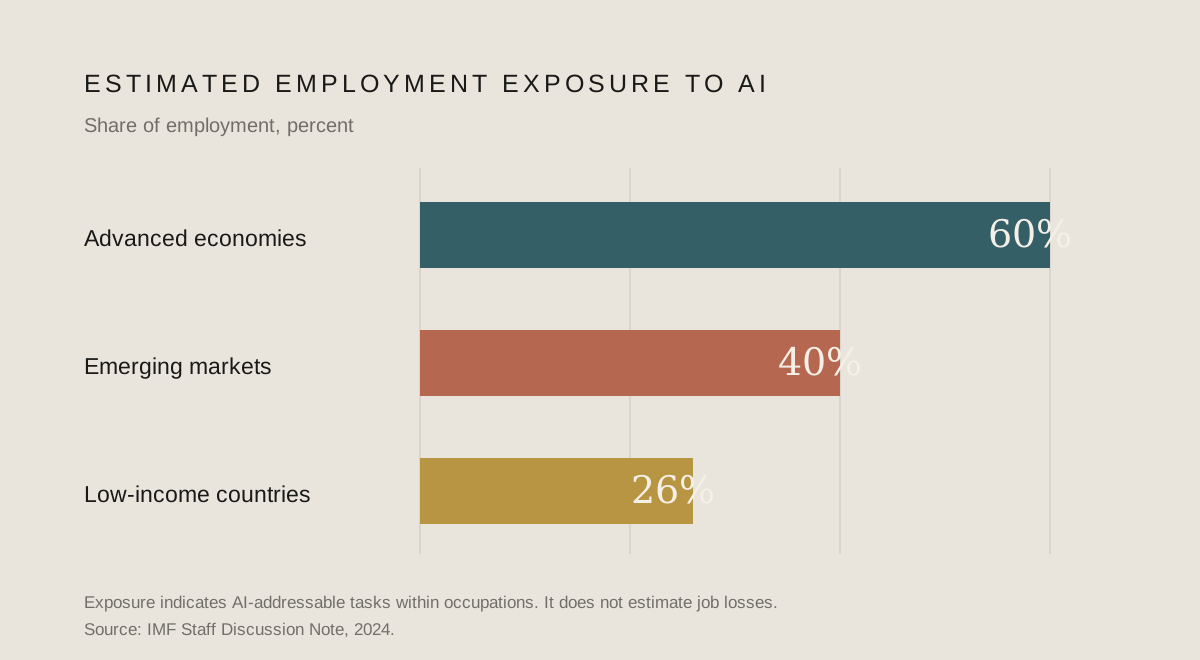
This creates a global paradox. Low-income countries may lose fewer jobs to AI in the near term, yet fall further behind if they cannot afford compute, connectivity, modern software, or training. A call-center economy can be highly exposed even when the country around it is not. A rural service economy may be less exposed but gain little from the new productivity frontier. The relevant divide is not simply “automated” versus “safe.” It is who can reorganize around the technology and who cannot.
The distribution within countries is just as uneven. Clerical work remains the most exposed. In high-income countries, the ILO estimates that occupations in the highest exposure category account for 9.6% of female employment, compared with 3.5% of male employment. This is not because AI targets women. It reflects occupational segregation: women are more concentrated in administrative and clerical roles whose tasks are easier to digitize.
What the evidence says so far
The first workplace studies show substantial task-level gains, but limited evidence of economy-wide displacement.
In a study of 5,172 customer-support agents, published in the Quarterly Journal of Economics, access to an AI assistant increased issues resolved per hour by 15% on average. The least experienced and lower-skilled agents benefited most. The tool helped novices reproduce some of the language and problem-solving patterns of better workers. Customers were also less hostile, and newer workers were less likely to leave.
That sounds like augmentation. It can become displacement later. If ten agents can handle the work of eleven or twelve, a growing company may serve more customers with the same team. A mature company may simply stop replacing people who leave. The initial productivity study cannot tell us which response will dominate.
Administrative data from Denmark offer a useful counterweight to the more aggressive forecasts. Researchers linked large worker surveys with payroll records and found no measurable effect larger than 2% on earnings or recorded hours during the first two years of chatbot adoption. Tasks changed and some workers switched occupations, but the aggregate labor outcomes barely moved.
The quiet national picture can coexist with pain in a particular cohort. The November 13, 2025 version of Stanford Digital Economy Lab's Canaries in the Coal Mine? reported a 16% relative employment decline for workers aged 22 to 25 in highly AI-exposed occupations, controlling for firm-level shocks. The 16% estimate belongs to that version of the study.
The August 2026 revision extends the data through June 2026 and reports a 19% employment shortfall for exposed young workers relative to the path of their less-exposed peers. This is not a finding that AI eliminated 19% of their jobs. The authors emphasize descriptive patterns, sensitivity to education and specification choices, and differences between their ADP sample and national survey benchmarks. Because the revision changes the data and analytical framing, 19% minus 16% is not a clean measure of how much an AI effect grew.
Taken together, the evidence points to a labor market that adjusts at the margin. Companies reduce junior openings, leave vacancies unfilled, combine roles, and raise output expectations. Those changes can be nearly invisible in headline unemployment while still closing the door on a generation trying to enter a profession.
The short term: hiring changes before jobs disappear
Through the next two or three years, AI’s largest employment effect is likely to come through hiring, work intensity, and job design rather than mass layoffs.
The most exposed workflows share three properties: the input is already digital, performance can be checked cheaply, and errors are reversible. Routine analysis, basic copy, document review, bookkeeping, translation, customer support, and straightforward coding all fit this pattern. Firms do not need a fully autonomous “AI employee.” They need tools good enough to reduce the time spent on the average case while humans handle exceptions.
Physical, relational, and liability-heavy work moves more slowly. Construction, caregiving, hospitality, field maintenance, and much of health care require hands in the world. Teachers, physicians, managers, and attorneys may automate documentation and research while remaining accountable for the outcome. In these jobs, AI can change the ratio between administrative work and human work long before it changes the number of workers.
The immediate danger is that firms capture time savings by raising the pace of work. The OECD’s workplace surveys found that four in five workers using AI said it improved their performance, while workers also reported concerns about work intensity, data collection, and inequality. Productivity and job quality do not automatically move together.
The medium term: the apprenticeship problem
Between roughly 2028 and 2033, the harder question will be organizational, not technical. Firms will redesign processes around AI instead of placing a chatbot on top of old routines.
That redesign could produce smaller teams with wider spans of control, fewer layers of coordination, and more output per experienced employee. It will also expose a structural problem: many professions train experts by paying novices to do routine work. Junior analysts build models. New lawyers review documents. Young programmers fix bugs. Residents write notes. If machines absorb the simple tasks, the profession may become more productive today while weakening the pipeline that produces senior judgment tomorrow.
The answer is not to preserve low-value work for its own sake. Employers will need explicit apprenticeships in which junior workers observe decisions, test AI output, rotate through exceptions, and receive feedback on judgment rather than merely produce first drafts. That costs money. Companies that free-ride on other firms’ training may discover, years later, that the market has plenty of prompt-fluent workers and too few people who know when the prompt is wrong.
Employment outcomes will then depend on demand. If AI lowers the cost of legal advice, software, tutoring, diagnosis, design, or financial planning, more people may buy those services. Total employment can rise even as labor required per unit falls. Where demand is fixed, productivity gains are more likely to reduce head count. Where demand is elastic, lower prices can expand the market.
This is why a single global job-loss number is misleading. Health care and education face enormous unmet demand. Media and routine business services face tighter demand and intense price competition. Manufacturing combines AI with capital equipment and robotics, so adoption moves at the speed of factories, not software demos. Government and regulated industries move at the speed of procurement, liability, and public trust.
The long term: three futures, not one forecast
Beyond the early 2030s, the uncertainty favors scenarios with explicit conditions over a precise employment forecast.
The augmentation case is the most plausible base case. AI remains powerful but imperfect. Humans keep responsibility, context, relationships, and control of physical systems. Productivity rises, new services appear, and occupations change faster than they disappear. Employment remains high, although wage gains favor workers who combine domain expertise with the tools.
The polarization case is less comfortable and nearly as plausible. A small group of owners and highly leveraged professionals captures much of the value. Mid-level cognitive work thins out, entry routes narrow, and lower-paid in-person services continue to grow. Unemployment may remain moderate while inequality, insecurity, and regional divergence worsen.
The broad-displacement case requires more than better chatbots. It requires autonomous systems that are reliable across long workflows, inexpensive enough to deploy widely, legally acceptable and, in physical industries, paired with capable robotics. If those conditions arrive faster than new demand and new institutions, labor displacement could spread well beyond clerical work. At that point, stronger income redistribution or a new social contract would move from ideological debate to practical necessity.
The World Economic Forum’s employer survey expects enormous churn by 2030: 170 million jobs created and 92 million displaced across AI, demographics, the energy transition, and other macro trends. The net gain of 78 million is often quoted as a forecast. It is better read as a survey of employer plans, useful for direction but far too uncertain to serve as a promise.
What governments should do now
Governments do not need to predict the exact automation curve. They need systems that work across several plausible curves.
-
Measure transitions, not just unemployment. Statistical agencies should track vacancies, hiring by experience level, task changes, AI use, hours, wages, and occupational mobility. A stable unemployment rate can conceal a collapsing entry ladder or a sharp rise in work intensity.
-
Fund retraining only when it connects to a job. Generic online courses are easy to announce and easy to ignore. Better programs combine employer demand, paid time to learn, recognized credentials, placement, and follow-up wage data. Older and lower-income workers need income support while training, not merely access to a portal.
-
Rebuild apprenticeship routes. Tax credits, procurement rules, and professional standards can encourage firms to keep training junior workers even when AI can perform the first draft. Public-sector employers should do the same. The objective is not to protect busywork; it is to preserve the formation of judgment.
-
Make benefits portable and adjustment support automatic. Unemployment insurance, health coverage, pensions, wage insurance, and relocation support should follow workers across employers and forms of work. Benefits that arrive only after a political emergency will arrive late.
-
Give workers rights around workplace AI. People should know when systems monitor them, allocate shifts, score performance, or recommend dismissal. They need a route to human review and a meaningful voice in deployment. The ILO and OECD both find that worker consultation and social dialogue are associated with better implementation. This is not because workers resist every tool, but because they know where the workflow actually breaks.
-
Spread the productivity gains beyond frontier firms. Smaller businesses and poorer countries need connectivity, digital public infrastructure, managerial skills, and access to competitive tools. Otherwise AI will widen productivity gaps even where it causes little direct displacement.
-
Keep the tax system neutral about people and machines. A blanket “robot tax” would discourage useful investment and invite endless arguments about what counts as a robot. Governments should instead remove tax biases that favor capital over labor, enforce competition policy, and tax extraordinary rents where they arise. The policy target is not automation itself. It is a distribution in which society absorbs the transition costs while a narrow group keeps nearly all of the upside.
The question underneath the jobs question
AI may eliminate some occupations. It will almost certainly eliminate pieces of many occupations, create others, and change the price of expertise. The pace will differ by industry, country, and business model. Anyone offering one number for “jobs lost to AI” is compressing a social process into a capability score.
The better question is who owns the productivity gain. It can become lower prices, better services, shorter workweeks, higher wages, and new demand. It can also become thinner teams, weaker bargaining power, more surveillance, and larger returns to capital. Technology constrains the possibilities. Institutions and management choose among them.
Keeping entry routes open will require firms to fund training even when AI can already perform the tasks that once paid for it.
Sources
This analysis distinguishes occupational exposure from observed employment effects and treats long-range outcomes as scenarios rather than point forecasts. Updated September 23, 2026: the Stanford claim now links to its November 13, 2025 version, which supports the historical 16% figure, and distinguishes the 19% descriptive shortfall in the August 2026 revision. The original publication date is retained; this update does not turn the other studies into September 2026 estimates.
- International Labour Organization and NASK, Generative AI and Jobs: A 2025 Update
- International Monetary Fund, Gen-AI: Artificial Intelligence and the Future of Work
- Brynjolfsson, Li, and Raymond, Generative AI at Work, Quarterly Journal of Economics
- Humlum and Vestergaard, Still Waters, Rapid Currents, NBER Working Paper 33777
- Brynjolfsson, Chandar, and Chen, Canaries in the Coal Mine?, November 13, 2025 version
- Brynjolfsson, Chandar, and Chen, Canaries in the Coal Mine?, August 2026 revision, Stanford Digital Economy Lab
- OECD, Using AI in the Workplace: Opportunities, Risks and Policy Responses