
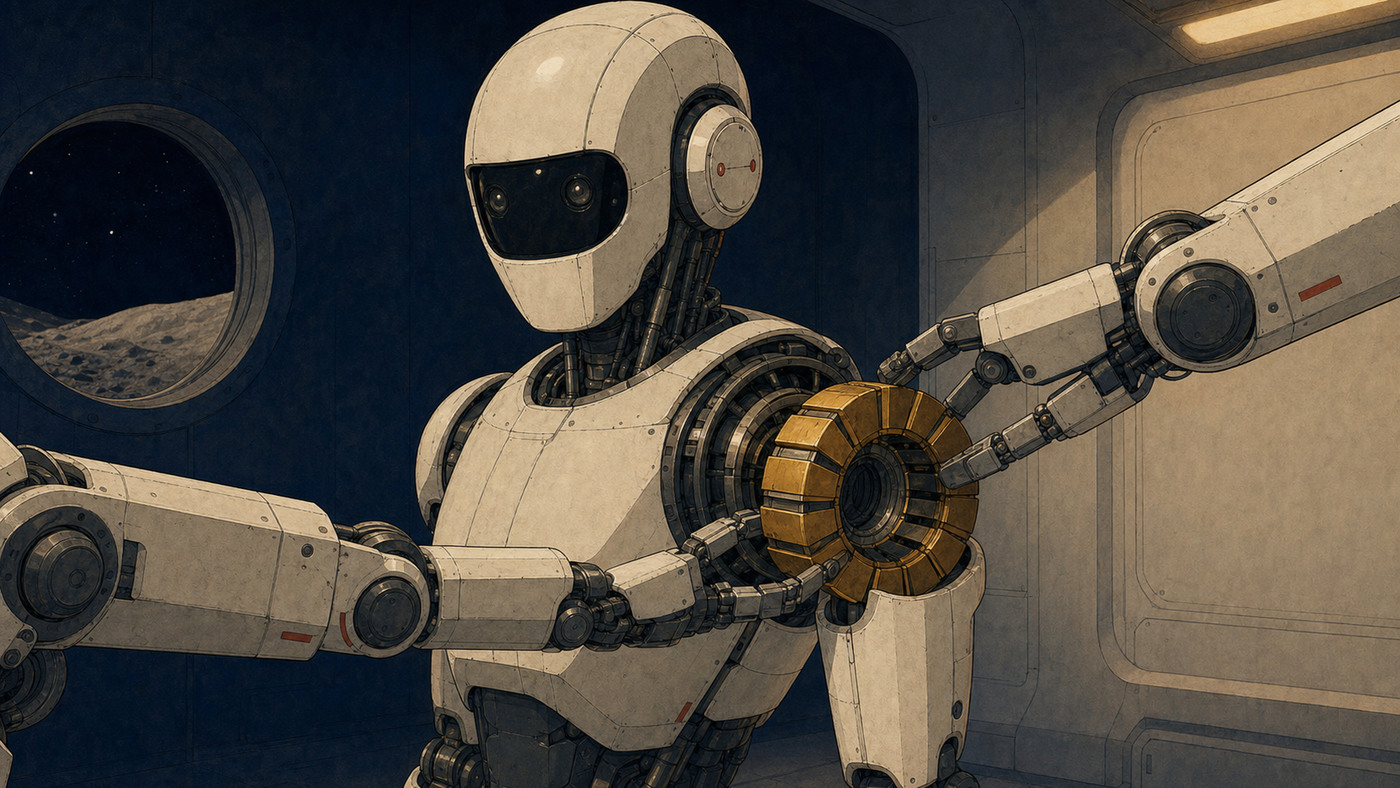
Watch a humanoid robot lift a tote, turn at the waist, or recover from a shove and the software seems to be doing all the work. The machine is reading the room, estimating its balance, and revising a plan in milliseconds. That is the part we can see.
The muscle is easier to overlook. Behind the white shell are compact electric motors, often one for every consequential joint. Many of those motors depend on neodymium-iron-boron permanent magnets. Neodymium and praseodymium provide magnetic strength; dysprosium and terbium can help that strength survive heat. Copper carries the current, bearings support the load, reducers trade speed for torque, and magnets make the package small enough to fit inside a shoulder or wrist.
This creates an awkward asymmetry. The magnets may represent a modest fraction of a robot's cost, but a missing custom magnet can stop the entire assembly line. Software can be copied to the next machine. A qualified magnet cannot.
The robot industry is therefore inheriting a supply problem that electric-vehicle and defense manufacturers already know well. It is not primarily a shortage of rocks. It is a shortage of alternative industrial systems capable of turning those rocks into consistent, high-performance magnets at scale.
Why robots care so much about a small piece of metal
An actuator converts electrical energy into motion. In a humanoid, it must produce substantial torque, respond precisely, fit into a narrow limb, shed heat, survive repeated impacts, and consume as little battery power as possible. These requirements fight one another. A larger motor may be easier to cool, but it adds weight. Added weight requires more torque in the joint above it, which means a larger motor, a stronger frame, and a larger battery. Poor torque density can spread through the entire design.
Sintered NdFeB magnets are useful because they are the strongest commercially available permanent magnets. The U.S. Department of Energy describes them as particularly valuable in efficient, low-weight motors and generators. That advantage matters in a factory arm, but it matters even more in a walking machine that carries every gram it adds.
Not every robot joint must use the same motor or magnet grade. Designers can choose induction motors, switched-reluctance motors, ferrite magnets, hydraulic systems, or different transmissions. A stationary arm can tolerate compromises that a mobile humanoid cannot. Even within one robot, a hip and a finger have very different jobs.
Still, the general direction is clear. More mobile robots mean more compact motion systems. More capable humanoids mean more actuated degrees of freedom. The International Federation of Robotics counted 542,076 new industrial robot installations in 2024 and an operational stock of 4.66 million. Humanoids remain a small part of that base, but they are unusually actuator-dense machines. If their production moves from thousands to hundreds of thousands, magnet procurement will stop being an engineering footnote.
A mine is only the first step
The phrase “rare earth supply” hides most of the work.
Ore must be mined and concentrated. Mixed rare earths must then be chemically separated into individual oxides. The oxides are converted into metals, combined into alloys, milled into fine powder, pressed in a magnetic field, sintered, heat-treated, machined, coated, magnetized, measured, and qualified for a particular customer. Yield, grain structure, oxygen control, coating quality, and thermal performance all matter. A country can have a mine and still lack a magnet industry.
The concentration increases at every important step. According to the International Energy Agency, China produced about 60 percent of mined magnet rare earths in 2024, 91 percent of refined output, and 94 percent of sintered permanent magnets. The last number is the one robot makers should keep on the whiteboard. Mining receives the political attention, but finished magnets are the product that must arrive at the actuator factory.
China's advantage was built over decades. A large domestic market connected miners, separators, metal makers, equipment suppliers, magnet producers, motor manufacturers, engineers, and customers. The result is not simply lower labor cost. It is a manufacturing ecosystem with accumulated process knowledge and short feedback loops. Reproducing a mine is difficult. Reproducing the cluster around it is harder.
The IEA's 2026 assessment makes the mismatch visible. Outside the dominant supplier, announced mining projects could create nearly 50 kilotonnes of capacity by 2035. Announced refining capacity is smaller, and planned metal, alloy, and finished-magnet capacity totals only about 18 kilotonnes on a rare-earth-content basis. Digging more ore without building the middle and end of the chain leaves the strategic dependence largely intact.
The warning arrived in 2025
On April 4, 2025, China's Ministry of Commerce imposed export controls on seven medium and heavy rare earth categories, including dysprosium, terbium, and samarium-related permanent-magnet materials. The rules required licenses rather than imposing a blanket ban. That distinction mattered legally, but it offered little comfort to a production manager waiting for an approval.
Exports fell sharply in April and May. The IEA later reported that automakers in the United States and Europe struggled to obtain magnets, with some reducing utilization or temporarily stopping production. Shipments recovered as licenses were granted, yet the episode demonstrated how quickly an obscure input could reach the factory floor.
Robotics companies face the same exposure with less protection. Large automakers buy in enormous volumes, maintain supplier-quality teams, and can negotiate long-term contracts. Defense customers can invoke national policy. A young robot manufacturer may be ordering custom shapes in modest batches while changing its motor design every few months. It has less purchasing leverage, less inventory, and a greater chance that an alternate magnet will require new thermal, torque, acoustic, and durability tests.
The problem is especially uncomfortable for Western humanoid startups. Their ambition requires automotive-style scale, but their procurement organizations are not yet automotive in scale. The firms most likely to secure supply will be those that treat magnets and motors as part of the product architecture early, rather than as catalog components to be sourced after the design is frozen.
Robots will not consume the world's magnets tomorrow
It is tempting to multiply a speculative magnet weight by a speculative humanoid forecast and declare a shortage. That arithmetic looks precise and usually is not.
Robot makers rarely publish the magnet content of their machines. Architectures differ, designs are changing, and an actuator count does not translate cleanly into kilograms of NdFeB. More important, vehicles, wind turbines, industrial motors, electronics, and defense systems already form much larger demand pools. The IEA expects demand for neodymium, praseodymium, dysprosium, and terbium to grow by more than 30 percent by 2030 under current policy settings, driven mainly by electrification. Automation and robotics become a more important part of the demand story after 2030.
That timing changes the conclusion. The first constraint on humanoid production is unlikely to be a planet-wide lack of rare earth elements. Software reliability, useful task performance, actuator life, safety, battery endurance, manufacturing yield, and price all have a claim on that distinction.
Magnet supply is different. It is a low-cost input with a high disruption cost. Even a well-supplied global market can become unavailable to a particular buyer when licenses, geography, qualification, or political priority intervene. The risk is allocation, not just tonnage.
This also means an early humanoid boom would not need to overwhelm the whole magnet market to create trouble. It would only need to strain the specific grades, shapes, coatings, and delivery schedules required by a fast-growing group of actuator suppliers.
The expensive effort to build a second system
Governments and manufacturers have begun to respond. MP Materials started manufacturing NdFeB magnets at its Independence facility in Texas in December 2025. The initial plant is designed around roughly 1,000 metric tons of annual finished-magnet capacity. Its planned 10X campus is much larger and is supported by a ten-year Pentagon offtake commitment. A separate public-private agreement established a $110-per-kilogram floor for qualifying NdPr products and committed government capital to the company.
Those terms are evidence of progress, but they also reveal the economics. A new non-Chinese supply chain needs patient capital, purchase guarantees, and protection from price swings. China can lower upstream prices and make a new separator or magnet plant look uneconomic long before the strategic need disappears. Private investors asked to fund a multi-year ramp will remember that rare-earth prices have repeatedly moved from panic to glut.
There are other projects in the United States, Europe, Japan, Korea, and Australia. Some will work. Press-release capacity should not be counted as qualified output, however. A finished automotive or robotic magnet must meet demanding specifications consistently, at commercial yield, and then pass the customer's tests. Commissioning equipment is the beginning of that process, not the end.
The IEA estimates that diversified magnet rare earth supply chains would require about $60 billion of investment over the next decade. Refining takes nearly half, and magnet manufacturing about one-third. That is a manageable sum relative to the industries at risk. It is also too large to be financed by slogans.
Substitution helps, but it changes the machine
There are three practical ways to reduce the exposure: use less rare-earth material, recover more of what has already been made, or design around it.
The first path is already commercial. Better motor geometry and techniques such as grain-boundary diffusion can reduce the amount of dysprosium and terbium needed to preserve performance at high temperatures. Manufacturers can reserve the highest grades for the joints that truly need them. This is careful engineering rather than a dramatic breakthrough, which is one reason it is likely to matter.
Recycling is attractive because the material has already survived the hardest separation steps. Old hard drives, motors, and factory equipment contain magnets that can be reused directly or processed into new feedstock. The technical progress is real, but collection and disassembly remain difficult, and today's retired products cannot immediately supply a robot industry that has not yet reached mass scale. Recycling will improve resilience gradually. It will not create a complete second supply chain on its own.
The third path gets the most attention. Iron-nitride magnets, advanced ferrites, induction motors, and switched-reluctance designs could remove or reduce rare earths. The Department of Energy is funding several of these approaches, including prototype rare-earth-free motors and pilot production of iron-nitride permanent magnets. None should be dismissed. None should be treated as a drop-in replacement either. Changes in magnetic strength, efficiency, heat, control complexity, noise, size, or weight can force a redesign of the actuator and everything around it.
For robots, substitution will probably be selective. A designer may accept a heavier, rare-earth-free motor in the torso while keeping high-performance NdFeB in distal joints where added mass is most costly. The winning architecture may use several motor types. Supply security will become another design variable alongside torque, cost, and battery life.
Where the durable value may sit
The robotics narrative naturally pulls investors toward robot brands and rare-earth miners. The more defensible economics may sit between them.
A deposit is valuable only if its material can be separated economically. Separated oxide is useful only if someone can turn it into consistent metal and alloy. A magnet plant creates value when it delivers the right magnetic properties, shape, coating, and yield, then survives a long qualification process. In this chain, technical capability and customer acceptance matter more than a large resource estimate.
That favors integrated producers, specialized magnet makers, motor companies with deep materials knowledge, and recycling businesses that can secure feedstock. It also favors robot manufacturers that control actuator design closely enough to qualify multiple materials and suppliers. A company buying a complete joint from one source may be faster to market, but it also inherits every hidden dependency inside that joint.
There is a caution on both sides. Subsidies and offtake guarantees can turn strategic capacity into a viable business, but they can also make returns dependent on policy. Scarcity premiums invite new supply. Alternative technologies improve when prices rise. A magnet producer can occupy an excellent strategic position and still be a poor investment at the wrong valuation.
For now, the useful evidence will be physical rather than promotional:
- tonnes of finished magnets produced at commercial yield, not announced capacity;
- customer qualifications and binding offtake, not memoranda of understanding;
- measured reductions in heavy rare earth content, not laboratory potential;
- robot production volumes and actuator designs, not distant unit targets;
- export-license timing and inventory coverage, not diplomatic reassurance; and
- recycling feedstock secured under contract, not a theoretical addressable market.
The real constraint is industrial
The robot boom will not run out of rocks. Rare earth elements are not especially rare in the Earth's crust, and new mining projects are advancing. The danger lies in the narrow industrial bridge between a mineral deposit and a reliable joint motor.
That bridge is concentrated in one country, technically difficult to duplicate, and newly exposed to export controls. Diversification is under way, but the slowest stages are the ones robotics needs most: metal, alloy, and finished magnets. Alternative motors will take some pressure off the system, while better design and recycling will stretch each kilogram. None is likely to erase the dependence quickly.
The most sophisticated robot on the factory floor may be guided by an AI model trained across thousands of GPUs. It will still rise, turn, grip, and walk through a chain of precisely manufactured magnetic fields. Intelligence may be the product. Motion is the prerequisite.
Sources
This report focuses on the industrial and investment implications of rare-earth permanent magnets in robotics. Robot architectures and material intensity vary widely, so it avoids unsupported estimates of magnet kilograms per humanoid. Company plans are treated as plans until commercial production and customer qualification are demonstrated. The analysis uses public information available through July 20, 2026.
- International Energy Agency, Global Critical Minerals Outlook 2026
- International Federation of Robotics, World Robotics 2025
- U.S. Geological Survey, Mineral Commodity Summaries 2026: Rare Earths
- China Ministry of Commerce, Announcement No. 18 of 2025
- U.S. Department of Energy, Rare Earth Permanent Magnets Supply Chain Assessment
- MP Materials, U.S. Department of Defense partnership
- ARPA-E, iron-nitride permanent magnet pilot production