

The rally moved faster than the cash engine
Circle Internet Group closed at $87.98 on August 21, 2026. Its shares gained 9.6%, 6.5%, and 5.2% over the final three sessions of the week. From the August 3 downgrade-day close of $60.35, CRCL rose 45.8%. The one-week gain from August 14 was 22.9%, according to daily closing data.
The August rally moved CRCL well above Morgan Stanley's target without resolving the bank's operating argument. Morgan Stanley cut CRCL from Equal-weight to Underweight on August 3 and reduced its target from $106 to $38. After Circle reported second-quarter results, the firm trimmed the target again to $37. The August 21 close was 137.8% above that target.
No single Circle announcement explains the full move. The price began climbing before earnings and accelerated after them, while Arc's September 16 public mainnet launch moved closer. The price action therefore looks like a blend of revised company expectations and investors buying ahead of Arc's launch. That interpretation is an inference from the timing, not a company disclosure.
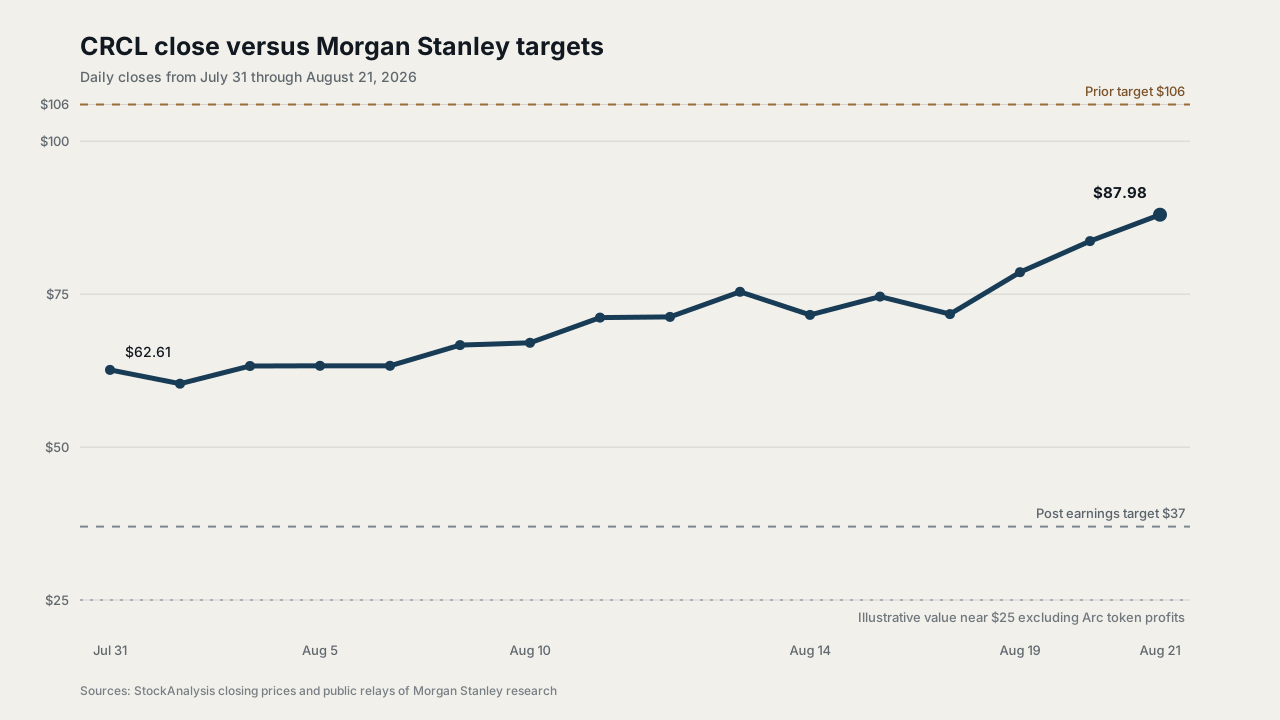
CRCL closed at $87.98 on August 21. Morgan Stanley's $37 post-earnings target sits below the entire displayed trading range, while its prior $106 target remains above it. Sources: StockAnalysis price history and public relays of Morgan Stanley research.
Arc's presale changed the August outlook
Circle gave investors a concrete reason to value more than reserve income. In its second-quarter earnings call, management raised 2026 other-revenue guidance to $310 million to $330 million from $150 million to $170 million. The increase comes from Arc. Circle completed a $242 million presale of the ARC Token and expects to recognize $180 million of that amount in 2026 as product milestones are achieved.
The accounting effect is unusually profitable. Management said the $180 million will flow directly to the bottom line, which lifted the full-year revenue-less-distribution-cost margin guide to 41.7% to 43.7% from 38% to 40%. Circle's August announcement scheduled the mainnet for September 16, with BlackRock, DTCC, ICE, Mastercard, Visa, Standard Chartered, and other institutions in the founding validator group. The presale and launch schedule gave investors concrete milestones to test.
Circle also disclosed that its agreement with Coinbase renewed on existing terms. That removes the idea of an abrupt 2026 expiration cliff. It does not remove the economic issue. Coinbase still receives a large share of reserve income, and Circle must continue paying other distributors to seed USDC balances and usage.
Buyers were willing to fund Arc before launch, which gives the network more than a theoretical value. The presale still tells investors little about recurring transaction fees, staking economics, validator revenue, or application demand. One interpretation of the rally is that investors treated the sale as evidence for a durable second earnings engine. The August outlook included expected revenue recognition from the presale; it did not establish the scale of subsequent recurring revenue.
Morgan Stanley's model begins with USDC balances
Public relays of Morgan Stanley's August 3 note show the bank rebuilding its forecasts around lower USDC circulation. It reduced its 2027 and 2028 supply assumptions by roughly 33% and 44%, respectively, placing its GAAP earnings estimates about 3% and 20% below consensus. It also argued that tokenized money-market funds, tokenized deposits, and Open USD could pressure both balances and the share of reserve economics Circle retains. The accessible note relay describes real payments as too small to offset pressure on the reserve-income model.
That analysis begins with three variables: USDC in circulation, the yield on its reserves, and the portion of gross reserve income left after distribution costs. If balances stall while interest rates fall, Circle earns less on each dollar and on fewer dollars. If competition forces higher payments to exchanges, wallets, and payment platforms, less of that income reaches shareholders.
Morgan Stanley maintained the bearish view after the earnings release. Its August 6 follow-up cited weak economics outside Arc, rising distribution costs, and growth initiatives that remain unproven. The relay said an illustrative valuation excluding Arc token profits would be closer to $25.
Open USD strengthens the distribution-cost concern, but the competitive mechanism is already covered in a separate InvisibleHill Research report, Open USD Is More Likely to Tax USDC Than Replace It. For CRCL, the relevant point is narrower: Circle can preserve USDC's network position and still lose profit per dollar if distributors capture more of the reserve pool.
Q2 did not settle the argument
Circle's Form 10-Q does not support a simple collapse story. USDC ended June at $73.3 billion, up 19% from a year earlier, while average circulation rose 25% to $76.5 billion. Reserve income increased 5% to $667.7 million despite a 66 basis point decline in the reserve return rate. Revenue less distribution costs reached $289 million, up 15%, and adjusted EBITDA rose 8% to $143 million.
There are also signs that Circle is improving its position inside the network. USDC held on Circle's platform reached $12.4 billion, up 106% from the prior year. A higher on-platform share matters because Circle retains more reserve economics there. The Coinbase renewal removes a near-term contractual uncertainty. The Q2 figures are better than a thesis built around immediate network deterioration would suggest.
The same filing explains Morgan Stanley's concern. Reserve income was still 95.2% of total second-quarter revenue. Other revenue before Arc recognition was only $33.6 million. Distribution, transaction, and other costs were $412 million, including $324.6 million tied to Coinbase. Adjusted operating expenses grew 23% to $146 million.
USDC balances have also stopped compounding at the rate required by the most optimistic models. Circle's public USDC page reported $72.7 billion in circulation on August 20, slightly below the June quarter-end level. One flat summer does not establish a long-term ceiling, but it leaves Morgan Stanley's central concern unresolved.
Interest-rate sensitivity makes that unresolved question expensive. Circle estimates that a 100 basis point decline from June's reserve yield would reduce annual reserve income by about $737 million and lower distribution and transaction costs by about $360 million. The net effect is a $377 million reduction before taxes, operating responses, or changes in USDC demand. Divided by the quarter's 268.6 million diluted weighted-average shares, that is about $1.40 per share before tax.
$51 separates the stock from the target
A fall from $87.98 to Morgan Stanley's $37 target would be a 57.9% decline. Conversely, $87.98 is 137.8% above $37. The bank's illustrative $25 value excluding Arc token profits would imply 71.6% downside. By contrast, the old $106 target was 20.5% above the August 21 close.
The market has not settled near the midpoint between the new and old targets. It has moved back toward the old case, even though current USDC supply remains in the low $70 billions and reserve yields have declined.
A fundamental case for the August 21 price would require USDC growth to offset lower rates and Arc, CPN, and other infrastructure to develop into a software-like profit pool. Those are analytical requirements for the bullish case, not evidence of every buyer's motive.
Different assumptions about future platform revenue offer one explanation for the $51 difference; price data alone cannot establish how much of the gap each assumption explains. Morgan Stanley is asking how much profit the existing reserve engine can produce under slower USDC growth. The bullish case gives Circle credit for becoming a transaction and infrastructure network before it reports recurring economics for that business separately.
The post-earnings facts improved
The August evidence is stronger than the facts available immediately before earnings. Circle more than doubled its other-revenue guidance. The Coinbase agreement renewed without a disclosed economic reset. Arc secured a large token presale, named a credible validator cohort, and set a near-term launch date. These are operating developments rather than another broad claim about the size of the stablecoin market.
A valuation that assigns no material value to Arc now ignores $242 million of presale demand and management's expected $180 million of 2026 recognition. Circle has enough liquidity to keep building through a weak digital-asset cycle. Its institutional participants also give Arc a stronger starting position than a typical new blockchain.
Those facts still stop short of recurring platform profit. Presale revenue is tied to milestones and token economics, so it cannot be annualized like a subscription stream. Validator participation shows institutional willingness to engage without revealing transaction volume. The scheduled September launch was a delivery milestone; measuring pricing power would require subsequent operating results.
Four disclosures will decide the argument
USDC balances
Quarter-end circulation can move around, so average balances matter more for earnings. A return above the $76.5 billion second-quarter average, sustained while reserve yields fall, would weaken Morgan Stanley's contraction case.
Arc revenue after token recognition
Circle needs to separate recurring Arc fees, staking, network services, and partnership income from token recognition. A large 2026 result followed by a drop after the presale has been recognized would confirm that the current profit step was temporary.
Retained margin
Revenue less distribution costs should keep growing after removing Arc token revenue. If USDC expands while the margin falls because distributors take more, the network can become more useful without becoming more valuable per share.
Fee income from payments and agents
CPN's annualized payment volume and Arc's transaction counts can grow rapidly from small bases. The useful disclosure will connect that activity to fees and gross profit. Until then, transaction figures demonstrate product use rather than an earnings engine.
CRCL has crossed into a platform valuation
Morgan Stanley's $25 illustration excluding Arc looks too severe as a complete value for Circle. Arc has already attracted capital and institutional participation, and it has a scheduled launch. The second-quarter update also justified a better view than one based only on shrinking USDC balances.
Justifying the $87.98 price through earnings would require Circle to preserve the reserve business while building recurring network profit fast enough to offset lower interest rates and expensive distribution. Q2 improved the probability of that transition, but most of the reported Arc benefit is still token presale recognition.
Our reading of the August 21 valuation is that it assigned substantial value to recurring Arc economics. Morgan Stanley's $37 case treats them as unproven and values the reserve-income company that still produces nearly all reported revenue. At the time of this August analysis, the September 16 launch was the next delivery test. Launch alone would not establish recurring economics; subsequent disclosures would need to show fees and retained margin before the market could measure how much of the $51 difference had become earnings.
Sources
Corrected September 23, 2026: the move from $87.98 to $37 is 57.9% downside, while $87.98 is 137.8% above $37. Market-motivation statements are now identified as interpretations. The prices and launch expectations below retain their August research dates.
Research uses public information available through August 24, 2026. Morgan Stanley figures are identified as public-source reconstructions because the full reports were unavailable. Calculations use the cited closing prices, company filings, and disclosed diluted share count.
- StockAnalysis, CRCL daily closing prices
- Benzinga, public relay of Morgan Stanley's August 3 downgrade
- TipRanks and TheFly, public relay of Morgan Stanley's August 6 follow-up
- Circle, second-quarter 2026 earnings call transcript
- Circle, second-quarter 2026 Form 10-Q
- Circle, current USDC circulation and reserve information