
The reported deal targets a model development system
The reported $6 billion Poolside agreement would give Nvidia a model development system while leaving Poolside independent. Recruiting the people who operate that system is a separate part of the proposed transfer.
Newcomer reported from a Poolside investor letter that Nvidia agreed to pay $6 billion for a non-exclusive license to Poolside's Model Factory, invest another $1 billion at a $12 billion pre-money valuation, and keep Poolside independent with the right to license the technology elsewhere. The Information separately described planned offers to 109 Poolside employees. Offers do not establish how many employees accepted or joined Nvidia. The Wall Street Journal reported that Nvidia plans to use the agreement to build a leading U.S. open-weight model and compete with Chinese models such as DeepSeek and Kimi K3.
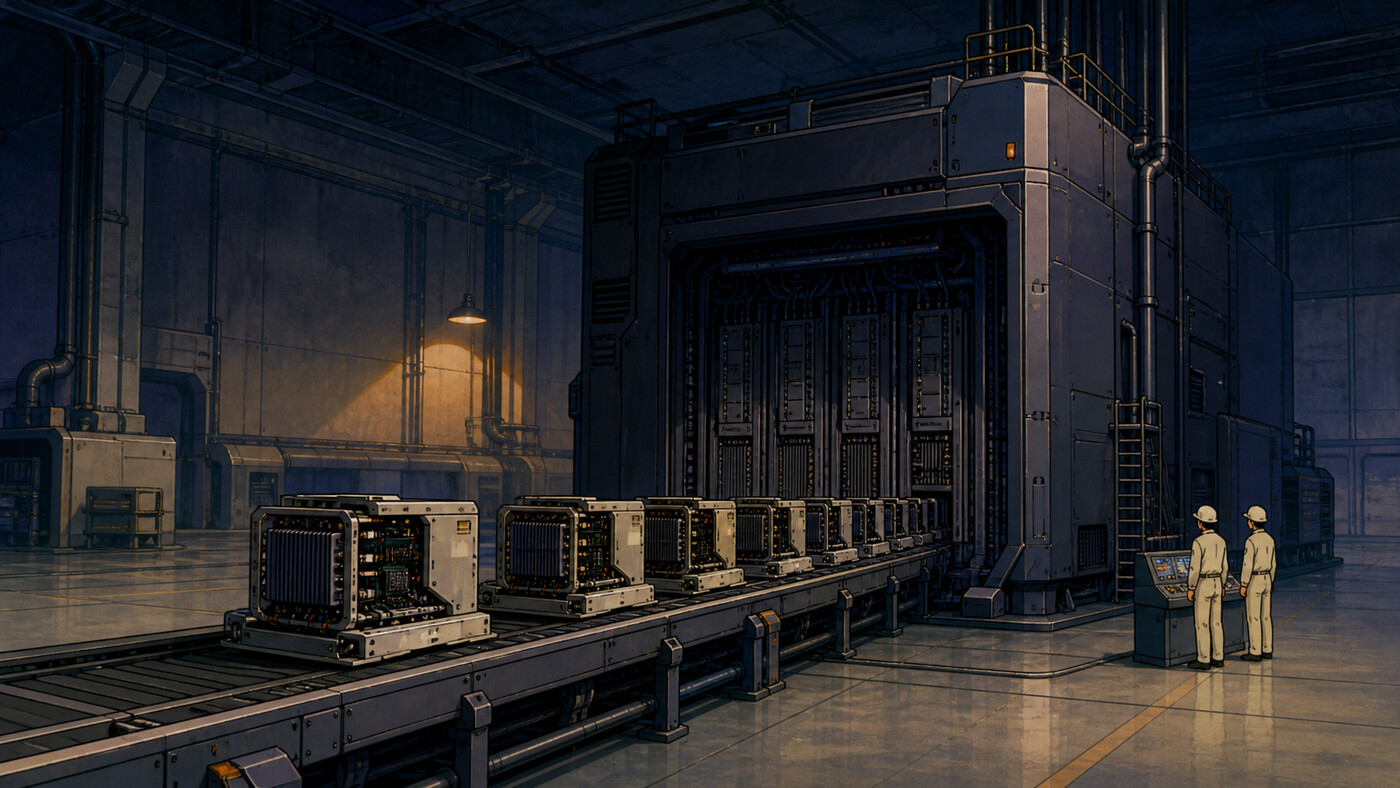
The Model Factory is more valuable than any single Laguna checkpoint because it is the repeatable process behind the checkpoints. Poolside describes it as a versioned system for data, training, evaluation, reinforcement learning, and inference. Its technical report says Laguna M.1 and XS.2 were trained from scratch inside that system. XS.2 moved from the start of training to release in five weeks. The system turns architecture tests, data mixtures, post-training, and benchmark feedback into a production loop.
A repeatable training system can support successive releases as architectures, data, and evaluations improve. Under the reported terms, Nvidia would license the factory and recruit employees who know how to operate it. Software and documented processes are only part of that capability. The hiring effort would also bring knowledge acquired during training runs and model releases.
The agreement is therefore closer to buying a model development capability than buying an AI product. Its non-exclusive form also creates execution risk. Nvidia still needs the engineers to accept their offers, integrate with its research organization, and reproduce Poolside's cadence inside Nemotron.
Open weights are a hardware demand strategy
Nvidia does not need Nemotron to earn the same API margins as OpenAI or Anthropic. It needs capable models to remain abundant, customizable, and easy to run on Nvidia infrastructure.
The company states this logic unusually clearly in its first-quarter fiscal 2027 filing. High-quality open models make advanced AI broadly accessible. Demand for those models promotes use of Nvidia products. If the most important models are developed or deployed on competing platforms, Nvidia could lose developer engagement and product demand.
Nemotron addresses both sides of that risk. Open checkpoints let enterprises, governments, and software vendors control weights, tune behavior, and deploy inside their own security boundaries. Nvidia then supplies the processors, interconnects, systems, optimization software, and support around those deployments. The model itself can be free because the economic return arrives through more training, fine-tuning, and inference on the surrounding platform.
Funding better open models gives more organizations a reason to train, adapt, and serve them on Nvidia systems. If model intelligence becomes cheaper and more widely distributed, the number of organizations running models can rise even when the compute required for one task falls.
Open models also reduce Nvidia's dependence on a small group of frontier labs to create demand. They prevent one closed-model vendor from controlling the developer interface and deciding which hardware or cloud should sit underneath it. Nemotron gives Nvidia a usable default model, a source of workload data, and leverage in negotiations across the stack.
Nemotron's current advantage is efficiency
Nvidia has used the Nemotron name since 2023, but the current product is much more ambitious than the original 8-billion-parameter family. Nemotron 3 Ultra has 550 billion total parameters and activates 55 billion per token. Nvidia released base, post-trained, and quantized checkpoints along with parts of the training data. The architecture is designed around sparse activation and low-precision inference, which connects model design directly to the strengths of Nvidia's latest systems.
The benchmark snapshot used for the original August 24 analysis did not put Nemotron at the top of the open-weight market. In that Artificial Analysis comparison, Kimi K3 scored 60 on its Intelligence Index while Nemotron 3 Ultra scored 38. The same comparison measured Nemotron at roughly 157 output tokens per second versus 34 for Kimi K3, with a lower estimated cost per million tokens. Benchmark results depend on providers, settings, and task mix, but the gap captured the tradeoff in that snapshot: Nemotron is competitive on serving efficiency and remains behind the open-weight frontier on broad measured intelligence.
The rumored trillion-parameter successor has no public technical specification. Parameter count would also be a poor investment signal by itself. Sparse models can contain enormous total parameter counts while activating only a fraction for each token. A useful comparison includes task accuracy, active parameters, memory footprint, throughput, reliability, and deployment cost.
Poolside can help Nvidia shorten iteration cycles and improve coding and agentic training. A frontier result still depends on research execution. The next Nemotron release must close the capability gap without surrendering the speed and hardware efficiency that make the current family useful.
Competing with customers is deliberate but constrained
OpenAI, Anthropic, and other frontier labs are important sources of demand for Nvidia. A stronger Nemotron could pressure their API pricing, make private deployment more credible, and give enterprises another reason to use multiple models. Nvidia is choosing that tension because a more competitive model market spreads power among its customers.
The overlap stops short of a consumer chatbot fight. Nemotron competes for the model and deployment layer. Closed labs compete for model access, applications, and direct customer relationships. Both can continue buying Nvidia systems even while their models compete.
Nvidia benefits when no single lab controls the market. Frontier companies train the largest models and drive demand for new systems. Open models expand inference among enterprises that need customization, data residency, or lower unit costs. Supporting both groups keeps the addressable compute market wider than choosing one side.
The constraint is customer concentration. Three direct customers represented 21%, 17%, and 16% of Nvidia's revenue in the quarter ended April 26, 2026. A combined 54% exposure keeps Nvidia from treating major buyers as disposable. The reported Poolside agreement is one way to reduce exposure to customer power and custom accelerators while those same customers continue buying its systems.
The structure adds a regulatory risk. Nvidia already says competition authorities have requested information about its foundation models, investments, and agreements with model developers. A large non-exclusive license paired with offers to most of a startup's technical team may receive more scrutiny than an ordinary software contract, even if it does not meet the legal form of an acquisition.
The transaction is large for research and small for NVDA
Nvidia reported $81.6 billion of revenue in the first quarter of fiscal 2027. Data Center contributed $75.2 billion, or more than 92% of the total. Operating income reached $53.5 billion, and research and development expense was $6.3 billion. Management guided to $91 billion of second-quarter revenue.
Against those figures, the reported $6 billion license equals about 7% of one quarter's revenue and almost one full quarter of R&D expense. Including the separate $1 billion investment takes the package to about 9% of quarterly revenue. The commitment is unusually large for a research capability and manageable for Nvidia's finances.
There is no disclosed Nemotron revenue line and no basis yet for adding Poolside-driven sales to an earnings model. The near-term accounting treatment and payment schedule are also not public. Investors should not translate the headline amount into an immediate increase in revenue, margin, or earnings per share.
Any payoff will arrive over several product cycles. If open-weight inference becomes a larger share of enterprise AI, Nvidia can preserve the relevance of its platform even as value shifts away from closed APIs. If Nemotron becomes a common starting point for agents, Nvidia may gain more influence over optimization choices and deployment architecture. Those benefits would appear indirectly through Data Center growth, enterprise adoption, software attachment, and sustained margins.
The reported cost protects Nvidia's existing platform and should not be modeled as a separate revenue segment. Quarterly Blackwell demand, the Rubin transition, customer capital spending, gross margin, and supply execution will matter far more to the next year of earnings. Poolside matters to how durable those earnings can remain after the model market changes.
Cloud providers and workflow software gain only if they execute
A stronger open-weight ecosystem should create more options for cloud providers. Enterprises can choose a model, tune it on private data, and move between managed endpoints, dedicated clusters, and local deployments. That can raise demand for GPU capacity outside the largest frontier labs.
The benefit will not be evenly distributed. Clouds still need high utilization, efficient inference, strong networking, and a credible software layer. Open weights make models portable, which can intensify price competition between providers. Hyperscalers also have their own accelerators and may use open models to reduce dependence on Nvidia. More open-model usage is positive for total compute demand without guaranteeing wider cloud margins.
Forward-deployed engineering and workflow software have a clearer opening. When several models are good enough, buyers spend less time debating a benchmark leader and more time connecting models to permissions, data, evaluations, tools, and business processes. The scarce asset becomes knowledge of the customer's workflow and the ability to make an agent reliable inside it.
That favors software companies with proprietary data, distribution, and deep integration. It also favors teams that can adapt models on site for regulated or technically complex customers. A thin application that only resells model access becomes easier to replace. The economics of closed frontier labs face the opposite pressure because lower-cost open alternatives make durable API margins harder to defend.
Adoption will decide the investment value
If the reported license and recruitment effort are completed successfully, Nemotron could gain a faster development system and experienced staff. That would address a risk Nvidia itself has identified: popular open models could pull developers toward another hardware platform.
Nothing in the reported terms warrants a near-term earnings revision. The August 24 benchmark snapshot placed Nemotron behind Kimi K3 on broad measured intelligence. The reporting cited here does not establish completed payments, accepted job offers, or enterprise demand attributable to the agreement.
Bull case
Nemotron closes most of the capability gap while retaining a large cost and throughput advantage. Enterprises adopt it for coding agents, sovereign AI, and private workflows. Open-model inference expands the number of organizations buying Nvidia systems, and the model becomes a reference implementation for the company's full stack.
Base case
Nemotron becomes a capable, efficient option without leading the frontier. It supports selected enterprise deployments and protects Nvidia from relying entirely on third-party models. Successful integration would make the platform more durable while contributing little identifiable revenue on its own.
Bear case
Poolside's process proves difficult to transfer, too few engineers join, or the research organization loses its release cadence. Chinese open models keep a material capability lead, large customers shift more workloads to custom accelerators, and regulators constrain Nvidia's investment and licensing strategy. Better model efficiency could also reduce compute per task faster than new usage grows.
The first evidence should come from independent Nemotron benchmarks and disclosed team retention. Enterprise deployments, growth in Nvidia's AI Clouds, Industrial, and Enterprise category, software support adoption, and new regulatory disclosures will show whether the strategy is reaching customers. Total parameter count cannot substitute for those measures.
The reported deal could strengthen Nvidia's platform over several product cycles; its terms alone provide no basis for revising near-term earnings. Nvidia is trying to ensure that model commoditization increases demand for its stack instead of weakening it. The test is whether Poolside shortens Nemotron's release cycle, closes the capability gap, and produces enterprise deployments that can be measured in Nvidia's results.
Sources
Corrected September 23, 2026: the summary and opening identify the transaction as reported, and recruitment is described as job offers rather than completed hires. The cited reports do not verify closing or the number of employees who joined. Transaction details remain attributed to those reports. Financial figures use Nvidia's quarter ended April 26, 2026. Model comparisons use benchmark snapshots available on August 24, 2026.
- Newcomer, Poolside strikes $6 billion licensing deal with Nvidia
- The Wall Street Journal, Nvidia is spending $6 billion to build a powerful U.S. alternative to Chinese AI
- Poolside, Laguna M.1 and XS.2 technical report
- Nvidia, Nemotron 3 Ultra
- Nvidia, Form 10-Q for the quarter ended April 26, 2026
- Artificial Analysis, Kimi K3 compared with Nemotron 3 Ultra