
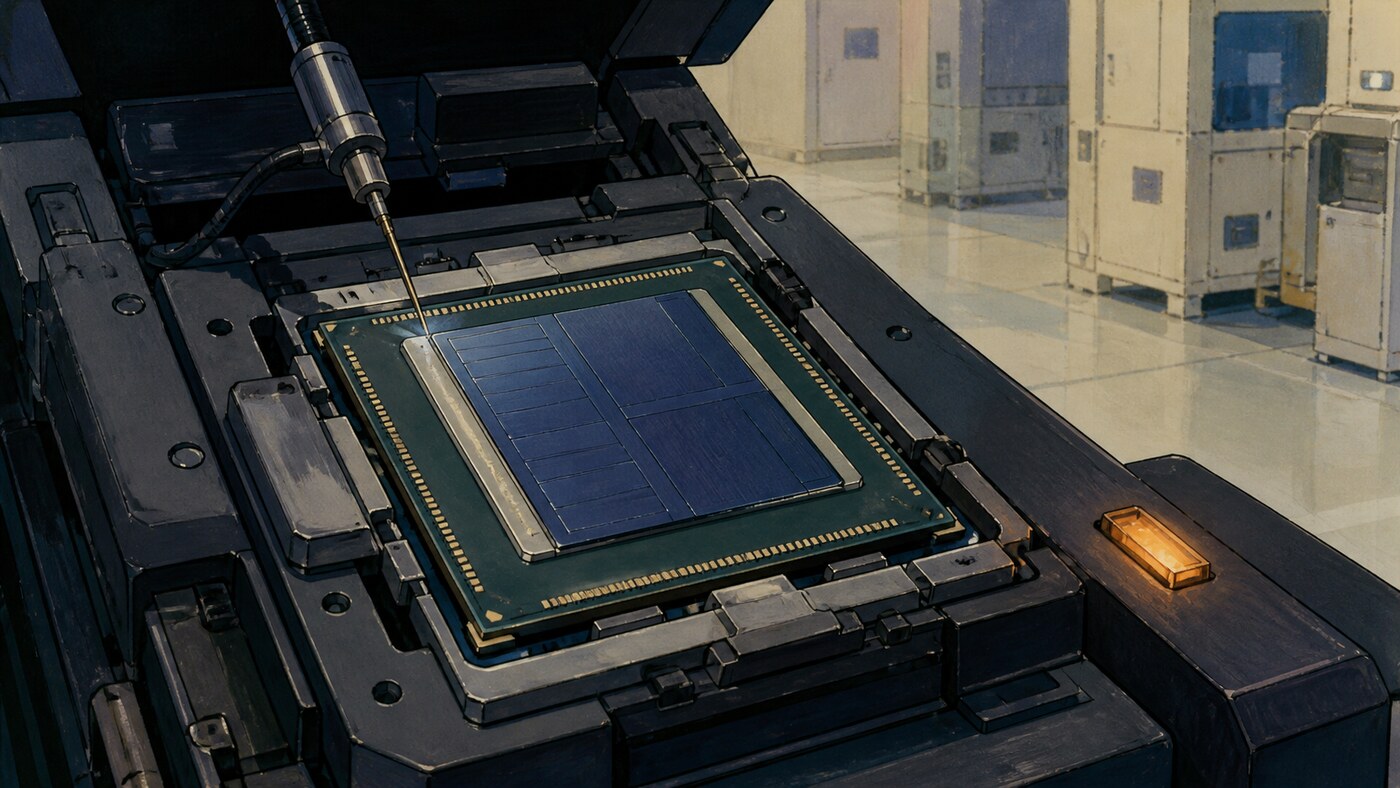
18A has moved from roadmap to production
Intel can finally point to physical proof of its manufacturing comeback. Base Intel 18A entered high-volume manufacturing in late 2025. Panther Lake PCs are in the market, Xeon 6+ launched in the second quarter, and 18A-P entered risk production in June 2026. Three years ago the process existed mainly on a roadmap. Today it is shipping silicon.
The node matters because Intel introduced two major changes together. RibbonFET replaces the older FinFET structure with a gate-all-around transistor. PowerVia moves power delivery to the back of the wafer, leaving more room for signal routing on the front. Intel changed the transistor and the way current reaches it in the same generation.
That is a harder engineering result than Intel's skeptics sometimes allow. The commercial test is separate. A process can manufacture Intel's own CPUs and still fail to attract enough outside volume at an acceptable yield and price. Can 18A and 18A-P turn a technically credible factory network into a profitable merchant foundry?
The customer list contains several kinds of evidence
The bullish case often groups every Intel partner into one list, as if an equity investment, a test chip, and a production order carried the same weight. They do not.
| Customer or program | What is confirmed | What is not yet confirmed |
|---|---|---|
| Amazon Web Services | A multi-year, multibillion-dollar framework that includes an AWS AI fabric chip on 18A and a custom Xeon 6 chip on Intel 3 | Production volume, shipment timing, and contract margin |
| Microsoft | Microsoft selected an unnamed chip design that it planned to manufacture on 18A | The public announcement did not identify the chip as Maia 2 or disclose volume |
| NVIDIA | NVIDIA invested $5 billion and the companies agreed to develop custom Intel x86 CPUs and PC systems that combine x86 and RTX chiplets | No public commitment says NVIDIA will manufacture its GPU dies on Intel 18A |
| RAMP-C | IBM, Microsoft, NVIDIA, Boeing, Northrop Grumman, and other participants used Intel's advanced process and packaging ecosystem for test chips and prototypes | Prototype work is not the same as a recurring commercial wafer order |
| Terafab | SpaceX, xAI, Tesla, and Intel are discussing a much larger domestic semiconductor ecosystem | The parties have warned that definitive agreements may never be signed |
AWS is the clearest named external 18A customer in public material. Its agreement dates to September 2024, not April 2026. Microsoft matters too, but the frequently repeated Maia 2 label goes beyond the original announcement. NVIDIA's investment and product partnership align two former rivals. For now, they validate Intel's x86 franchise more directly than its foundry order book.
RAMP-C carries strategic value. Defense and technology companies have worked through Intel's design tools, packaging, and security requirements, which is precisely the capability Washington wants on American soil. Test chips still tell shareholders nothing about utilization or margin.
Terafab is option value. Intel calls the work exploratory, while SpaceX says Tesla and Intel are not obliged to remain in the collaboration. Our separate report, Terafab: One Terawatt of Chips Is Not Yet a Capacity Plan, covers the disclosure in detail.
CPUs are funding the foundry option
The most important near-term Intel product may still be the CPU, not a merchant foundry wafer.
Intel's product businesses generated $15.14 billion of segment revenue and $4.82 billion of operating income in the second quarter of 2026. Client Computing contributed $8.88 billion of revenue and $2.34 billion of operating income. Data Center and AI produced $6.26 billion of revenue and $2.47 billion of operating income. Management said server demand remained strong enough to constrain supply in parts of the portfolio.
That profit is buying time for the turnaround. Hyperscalers need accelerators, but they also need host CPUs, memory capacity, networking, orchestration, and general-purpose compute. Intel can benefit from larger AI data centers without beating NVIDIA at training chips. Xeon must remain relevant, and the factories must convert that demand into attractive economics.
Panther Lake and Xeon 6+ do two jobs. They defend product revenue and force Intel to prove 18A inside high-volume products before outside customers commit larger designs. Internal products give the fabs anchor volume. External customers will still compare Intel's cost, yield, tools, and schedule with TSMC and Samsung before they fill the remaining capacity.
Foundry losses are narrowing from a very large base
Intel Foundry reported $5.77 billion of second-quarter segment revenue and a $2.09 billion operating loss. The loss improved from $3.17 billion a year earlier, a meaningful step. Still, only $293 million of the quarter's foundry, assembly, and test revenue came from external customers. Most reported Foundry revenue was generated by Intel's own product groups and eliminated in consolidation.
The $293 million figure is the one to watch. Impressive names can sit in a pipeline for years. Production ramps appear in revenue.
TSMC provides a rough scale check, although the segment accounting is not directly comparable. It reported $40.20 billion of second-quarter revenue and a 60.3% operating margin. Intel Foundry's segment operating margin was about negative 36%. This says little about which transistor is better and a great deal about the gap in customer volume, factory utilization, and financial maturity.
Management has committed to 14A development, and leading customers are evaluating early process design kits. The sequence matters: a PDK evaluation precedes a tape-out, which precedes a volume order. Intel expects early design commitments between the second half of 2026 and the first half of 2027. Named customers, production schedules, and economic scale will matter more than the number of evaluation conversations.
Capital bought time and more dilution
Intel did improve its ability to finance the turnaround. SoftBank invested $2 billion in 2025, NVIDIA invested $5 billion, and the United States government provided $5.7 billion of accelerated CHIPS Act funding plus $3.2 billion tied to Secure Enclave milestones. The often quoted total is about $15.9 billion.
The headline total hides the terms. SoftBank and NVIDIA received stock. The government arrangement involved an equity interest, escrowed shares, performance obligations, and conditional warrants if Intel loses control of its foundry business. Existing shareholders pay for part of that strategic support through dilution and constraints.
Then Intel returned to the equity market in August 2026. It sold 210.5 million shares at $95, and the underwriters exercised their option for another 31.6 million shares. The full offering added about 242.1 million shares and was expected to deliver roughly $22.62 billion of net proceeds. On the prospectus share count, that is about a 4.8% increase in shares outstanding.
June cash and short-term investments were $29.73 billion against $50.54 billion of debt. The equity proceeds leave Intel with far more room to fund process ramps. They also raise the earnings hurdle per share. More runway is welcome, but it says nothing about Foundry's eventual return on capital.
One accounting detail can easily mislead. Intel's second-quarter GAAP loss included a $12.5 billion noncash derivative charge because the value of government escrowed shares rose with Intel's stock. The headline loss therefore understates the quarter's operating progress. The manufacturing plan remains intensely cash hungry.
At $90, the required earnings are no longer modest
Intel closed at $90.07 on August 21, up about 129% from the first trading day of 2026. Applying that price to the roughly 5.285 billion shares expected after the full August offering gives a pro forma equity value near $476 billion.
Instead of attaching a heroic price target, start with the return the current price must produce. A 10% annual return for five years requires an equity value of about $767 billion in 2031, before dividends, repurchases, or future dilution.
| 2031 exit price-to-earnings ratio | Net income needed for a $767 billion equity value |
|---|---|
| 20 times | $38.3 billion |
| 25 times | $30.7 billion |
| 30 times | $25.6 billion |
Intel reported $2.2 billion of non-GAAP net income in the second quarter. Annualizing one quarter is crude, but the resulting $8.8 billion shows the size of the bridge. Depending on the exit multiple, net income would have to reach roughly three to four times that annualized level. Better product margins, smaller Foundry losses, external wafer profit, and a lower net interest bill can each carry part of the burden.
This is a test of what today's price asks the business to become. At $30 or $40, 18A success looked like inexpensive optionality. Around $90, the market already assigns substantial value to it.
The next proof points are operational
Intel is in better shape than it was when the debate centered on whether it could finance the roadmap. It has shipped 18A products, repaired parts of the CPU franchise, narrowed Foundry losses, added strategic capital, and gained time. The bullish thesis now rests on real evidence.
The next scorecard is harder and more financial:
- External foundry revenue should rise beyond a few hundred million dollars per quarter.
- AWS and other 18A designs should reach production with disclosed timing or observable volume.
- 14A evaluations should become committed designs from customers willing to be named.
- Foundry operating losses should fall without product groups absorbing uneconomic wafer costs.
- Product operating income should convert into cash after manufacturing investment.
- Share issuance should stop outrunning per-share earnings progress.
Intel has substantially reduced the risk that its process roadmap is fictional. Outside customers have yet to fill the factories at profitable prices. At about $90, INTC is a high-execution, long-duration turnaround rather than an inexpensive recovery trade. The stock can still work. The next leg needs foundry economics, not another list of interested partners.
Sources
- Intel Q2 2026 Form 10-Q
- Intel 2025 Form 10-K
- Intel August 2026 equity offering prospectus
- Intel Form 8-K confirming the underwriters' full option exercise
- Intel and AWS expand their strategic collaboration
- Intel Foundry launch and Microsoft's 18A statement
- TSMC second-quarter 2026 results
Market prices are daily closes through August 21, 2026. Financial calculations use Intel's post-offering share count and are rounded. Company claims are attributed to company filings or announcements; comparative judgments and valuation math are InvisibleHill Research analysis.