
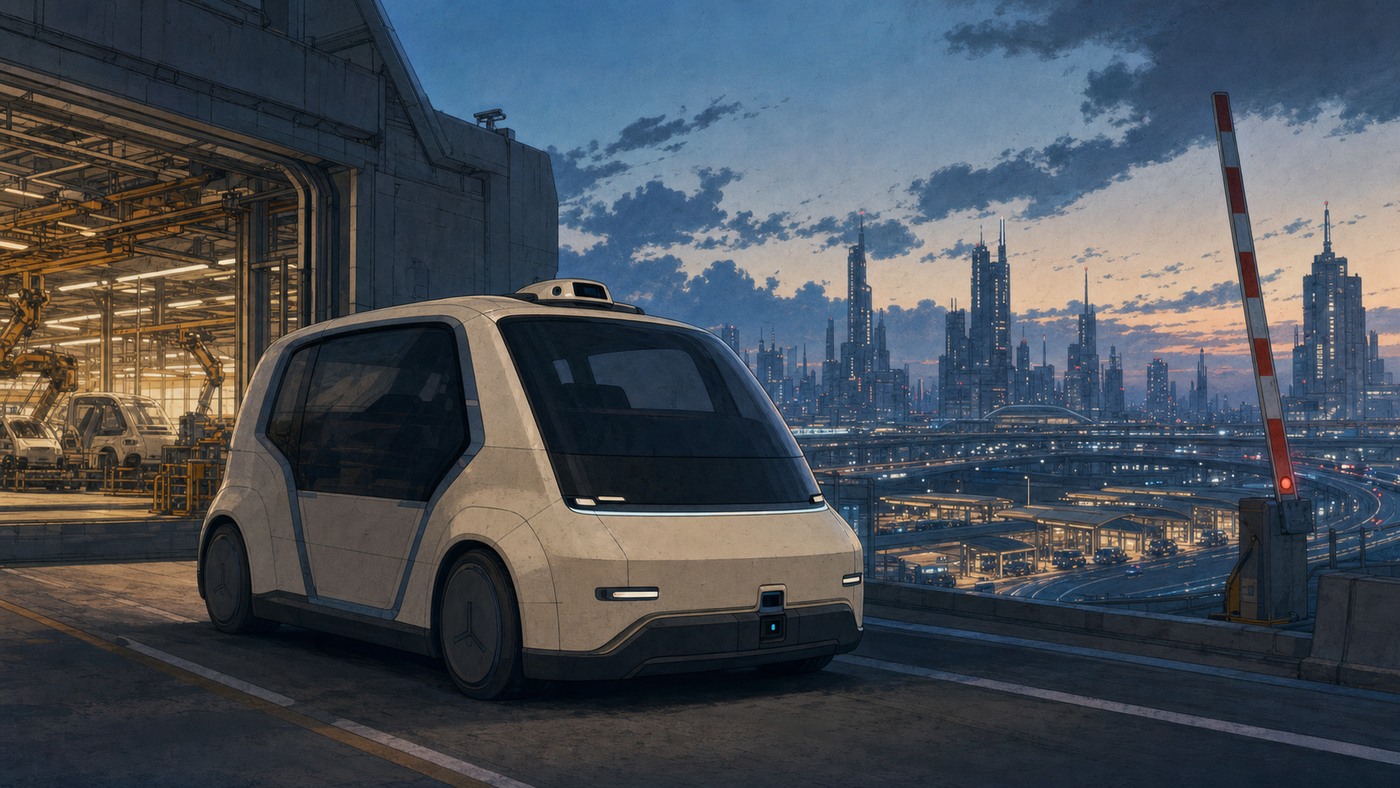
Tesla no longer needs investors to believe that Robotaxi is imminent. It needs to prove that Robotaxi is economic.
The service has moved beyond a presentation. Tesla launched paid rides in Austin in June 2025. Its second-quarter 2026 update says Robotaxi is now live in seven major U.S. metropolitan areas, Cybercab production has begun in Texas, and the company has started testing production Cybercabs on public roads. The same update also shows the limits of that progress. San Francisco Bay Area rides still use FSD (Supervised) with a safety driver, several cities are only ramping, and Tesla does not disclose Robotaxi revenue, fleet size, paid rides, interventions, insurance cost, or profit per vehicle.
That is enough evidence to treat Robotaxi as a business. It is not enough to value it as a global transportation utility.
The central investment question has two very different thresholds. Robotaxi can become larger than Tesla's present automotive business because removing the driver changes the economics of every mile and turns a one-time vehicle sale into years of service revenue. A $10 trillion valuation is much harder. At that price, Tesla would need several hundred billion dollars of durable annual earnings or free cash flow, not merely a large fleet and an impressive addressable market.
The first threshold looks reachable. The second does not yet. Robotaxi can plausibly outgrow Tesla's current car business during the 2030s. It is unlikely, on its own, to justify a $10 trillion Tesla. Reaching that valuation would require Robotaxi to become the dominant global paid-mobility network while Tesla's energy, automotive, FSD, and robotics businesses also compound. It is a possible outcome at the far end of the distribution, not a sensible base case.
The business Robotaxi has to beat
Tesla's car business is large, but its economics leave room for a service network to overtake it.
In 2025, Tesla's automotive and services segment produced $82.1 billion of revenue and $13.3 billion of gross profit, according to its annual report. The company delivered 1.64 million vehicles. In the second quarter of 2026, total automotive revenue was $20.5 billion and automotive gross margin was 16.9 percent. Tesla had to manufacture, ship, sell, warranty, and support nearly half a million vehicles in the quarter to generate $3.5 billion of automotive gross profit.
A car sale monetizes the vehicle once, with smaller service and software payments later. A Robotaxi can sell the same physical asset thousands of times. If it completes 50,000 paid miles a year at an average realized fare of $1 per mile, it produces $50,000 of annual gross bookings. A million such vehicles would produce $50 billion. The arithmetic becomes attractive before the fleet approaches the scale of the global car market.
Profit can cross over sooner than revenue. Driver compensation is the largest variable cost in conventional ride-hailing. An autonomous fleet replaces that cost with depreciation, electricity, cleaning, tires, repairs, insurance, remote assistance, deadhead miles, and local operations. Those costs are substantial, but they do not rise one-for-one with passenger time. If the system is safe and reliable, utilization can spread the vehicle's capital cost across far more miles than a private car.
This is why Robotaxi can become more valuable than vehicle manufacturing even if Tesla never sells more annual rides than cars. The current automotive segment produces a mid-teens gross margin and requires continuous factory throughput. A mature autonomy network could earn a fee on customer-owned vehicles, capture the full fare on Tesla-owned Cybercabs, sell FSD software, and create demand for vehicles, charging, insurance, and maintenance at the same time.
That operating leverage is real. It is also where optimistic models usually skip the hardest work.

Paid mobility is already a very large market
Robotaxi does not need to create a new consumer habit. People already pay to be driven.
Uber recorded $26.4 billion of Mobility gross bookings in the first quarter of 2026, or more than $105 billion at the same quarterly run rate. Its Mobility segment generated $6.8 billion of revenue and $2.0 billion of segment operating income. Those figures cover one platform, not the taxi and private-hire markets that remain outside Uber, and not the private-car trips that could shift if autonomous rides become materially cheaper.
The existing market is therefore large enough for a robotaxi leader to surpass Tesla's present car revenue. The larger opportunity comes from induced demand. Lower fares can make paid mobility useful for commuting, school trips, older passengers, teenagers, late-night travel, and households that keep one car instead of two. The vehicle can also serve deliveries during weak passenger periods, although freight and passenger demand do not line up perfectly and each use adds operational complexity.
There are limits to the addressable-market story. Public transit remains cheaper on dense routes. Walking and cycling cost almost nothing. Many suburban and rural trips are difficult to serve without long empty repositioning miles. Families value the storage, availability, child seats, and privacy of their own cars. A cheap ride does not automatically convert every private mile into a commercial fare.
The first market is taxi and ride-hailing. The second is a share of urban car ownership. Treating all global passenger miles as Robotaxi revenue is valuation theater.
The competitors already operating at scale reinforce both sides of the case. Waymo said it completed 15 million rides in 2025 and was providing more than 400,000 rides per week across six U.S. metropolitan areas by early 2026. Baidu reported 3.2 million fully driverless Apollo Go rides in the first quarter of 2026 and more than 22 million cumulative public rides by April. These are no longer laboratory programs. They also remain small beside the roughly 40 million trips per day that Uber's entire platform handled in the first quarter, including delivery.
Tesla enters a proven market with a plausible cost advantage. It does not enter an empty one.
Tesla's approach has unusual upside
Tesla's Robotaxi thesis is stronger than a simple plan to own a fleet of Cybercabs.
The company has three assets that a stand-alone autonomy developer must build or buy. It manufactures vehicles at global scale. It operates charging, service, parts, insurance, and retail infrastructure. It also collects driving data from a consumer fleet and can distribute new software over the air. If the same autonomy stack can move from an owned Model Y fleet to Cybercab and then to customer-owned vehicles, Tesla can scale supply without funding every car on its own balance sheet.
That last step matters most. A company-owned fleet resembles an airline or rental-car business: high revenue, high asset intensity, local depots, and recurring replacement capital. An owner-supplied network resembles a marketplace: Tesla collects a take rate while another party provides the vehicle capital. The owner-network model produces less reported revenue per ride but can produce much better returns on Tesla's own invested capital.
Tesla can also manufacture around Robotaxi economics. Cybercab removes a steering wheel and pedals, uses two seats, and is designed for high utilization rather than private ownership. The Q2 2026 deck lists installed annual Cybercab capacity above 125,000 units at the Texas factory. A purpose-built vehicle can reduce purchase cost, simplify cleaning, improve ingress, and lower energy use per passenger mile.
Vertical integration creates another option. Tesla can choose among selling a vehicle, retaining it for fleet revenue, licensing FSD, or sharing revenue with an owner. When vehicle demand is weak, the company can allocate production to its fleet. When capital is expensive or local partners have stronger operating knowledge, it can sell or finance vehicles instead.
The risk is that these models compete for the same economics. A vehicle owner will not contribute an expensive asset unless the return beats private use, leasing, or resale. A local fleet partner needs a margin. Passengers demand low prices. Tesla cannot simultaneously assume the full fare, no vehicle capital, no partner payment, and a software-like margin.
What a $10 trillion valuation requires
Tesla's market value was about $1.1 trillion on August 1, 2026. A $10 trillion outcome is roughly a ninefold increase. More important, it would be one of the largest concentrations of corporate profit in history.
At 30 times free cash flow, a $10 trillion equity value requires about $333 billion of annual free cash flow. At 25 times, it requires $400 billion. A faster-growing company can trade at a higher multiple for a period, but a business this large eventually has to be valued against cash that owners can receive.
Tesla's own compensation framework reveals the scale of the ambition. The 2025 CEO performance award uses a top market-capitalization milestone of $8.5 trillion by 2035 and includes operational milestones for one million Robotaxis in commercial operation, ten million active FSD subscriptions, one million bots, and as much as $400 billion of adjusted EBITDA. These are separate milestones for a reason. One million Robotaxis is a product-scale achievement. It is not enough earnings for an $8.5 trillion or $10 trillion company.
The following scenarios are not forecasts. They show how sensitive the valuation is to fleet size, utilization, price, and profit retention. Gross bookings equal paid miles multiplied by the realized passenger fare. EBITDA is shown after vehicle-owner payments or fleet operating costs, but before company-wide corporate costs.
| Robotaxi scenario | Vehicles in service | Paid miles per vehicle | Realized fare per mile | Annual gross bookings | Tesla EBITDA as % of bookings | Tesla EBITDA |
|---|---|---|---|---|---|---|
| Early scale | 1 million | 50,000 | $1.10 | $55 billion | 18% | $10 billion |
| Global leader | 5 million | 60,000 | $0.90 | $270 billion | 30% | $81 billion |
| $10 trillion support case | 15 million | 75,000 | $0.75 | $844 billion | 40% | $338 billion |

The early-scale case could rival the gross profit of Tesla's current automotive operation. It would not transform the valuation by itself. The global-leader case would be an extraordinary business, worth perhaps several trillion dollars when combined with Tesla's other operations, depending on growth, capital intensity, tax, and the multiple investors assign. It still falls well short of the cash flow normally needed for $10 trillion.
The final row is intentionally demanding. Seventy-five thousand paid miles per vehicle means an average of 205 revenue miles every day before empty repositioning, charging, cleaning, and downtime. Fifteen million vehicles would generate more than three trillion paid miles a year. Tesla would need to retain 40 cents of EBITDA from every dollar of bookings despite price competition, vehicle depreciation, insurance, local fleet operations, and payments to third-party owners.
That is not impossible in a world where autonomy becomes safer than human driving, private car ownership falls, and Tesla operates the winning network across major countries. It is not what the current evidence supports.
A more defensible path to $10 trillion combines businesses. Robotaxi might supply $100 billion to $200 billion of annual EBITDA; energy storage and generation could become a large infrastructure platform; automotive manufacturing and FSD could remain profitable distribution channels; Optimus might become commercial. Even then, the company would need unusually high margins and years of compounding after scale is visible. Robotaxi can be the largest contributor without carrying the entire valuation.
Engineering and fleet economics
The engineering problem is the tail, not the average drive
A useful Robotaxi must do more than complete most trips.
The system has to handle emergency vehicles, construction workers giving hand signals, flooded streets, unusual cargo, damaged lane markings, police direction, aggressive road users, pickup zones, and a passenger who opens a door into traffic. It must know when to stop and how to recover without creating a new hazard. A human driver can call a passenger, move a misplaced object, read a temporary sign, or negotiate with another driver. A driverless fleet needs product and operations systems for all of those cases.
Tesla's camera-only architecture may be cheaper and easier to manufacture than a vehicle carrying lidar and a larger sensor suite. Its global fleet can collect a wide distribution of visual driving data. Those are material advantages if the neural network learns a general driving policy that transfers across cities.
They do not remove the burden of proof. A supervised intervention avoided by a human driver is not the same as an unsupervised system resolving the event. Billions of consumer FSD miles can improve the model while still producing limited evidence about a driverless service's behavior, because the driver changes the outcome and may choose when to use the software. Regulators and insurers need Robotaxi-specific exposure, crashes, claims, interventions, and operational-domain data.
Waymo's lead is useful as a benchmark. Its February 2026 financing announcement cited 127 million fully autonomous miles and a 90 percent reduction in serious-injury crashes compared with a human benchmark. Those are company-presented results and still deserve independent scrutiny, but they show the scale of evidence a mature safety case can accumulate. Tesla's current disclosures do not allow an equivalent comparison.
The decisive metric is not miles between interventions in a friendly zone. It is loss per passenger mile across weather, road classes, time of day, vulnerable road users, and rare events, with enough exposure that a favorable result is statistically credible.
Fleet operations can erase software margins
Robotaxi is a physical service. The vehicle has to be clean, charged, repaired, secure, and in the right place.
Tesla's second-quarter 10-Q identifies the required infrastructure directly: cleaning and maintenance, charging, security, teleoperations, and fleet management. Each item can break the attractive per-mile model.
Cleaning is labor. A passenger who leaves food, becomes ill, smokes, or damages the cabin can remove a vehicle from service. Charging creates downtime and peak-power demand. Tires and suspension wear quickly under heavy urban utilization. Collision repair is costly even when the autonomous system is not at fault. Remote assistance can become a hidden driver cost if one operator cannot safely support many vehicles. Depots consume land in the most valuable service areas.
Utilization is also uneven. Demand peaks in the morning, evening, and after events. A fleet sized for Friday night can sit idle on Tuesday afternoon. Repositioning adds miles that consume energy and vehicle life without producing revenue. Airport and event pickup zones need agreements and curb capacity, not just driving software.
The best Robotaxi operator may therefore look less like a pure software company than optimistic margins imply. It needs the scheduling discipline of a logistics network, the maintenance control of an airline, and the local compliance of a taxi operator. Tesla has relevant operating infrastructure, but it has not yet reported the cohort economics that would show whether this work scales efficiently.
Regulation is not one approval
No global Robotaxi license exists. Vehicle design, automated-driving safety, commercial passenger service, insurance, mapping, data, and local road access are often governed by different authorities. Tesla must build a compliance product alongside the driving product.
United States: one vehicle rulebook, many operating rulebooks
NHTSA governs federal vehicle safety and can investigate defects and require crash reporting. A purpose-built Cybercab without conventional controls must either comply with applicable Federal Motor Vehicle Safety Standards or use an exemption. The current Part 555 route can exempt up to 2,500 vehicles per manufacturer per year and requires an equivalent level of safety. That is useful for an early fleet, not for millions of steering-wheel-free vehicles.
Deployment is primarily state-driven. Texas now requires authorization for commercial Level 4 or Level 5 operations without a human driver, proof of insurance, a minimal-risk capability, federal compliance, and an emergency-response plan. It restricts local governments from creating separate AV rules, which makes statewide expansion comparatively direct.
California is the opposite end of the spectrum. Its April 2026 regulations require manufacturers to progress from safety-driver testing to driverless testing and then deployment, complete 50,000 miles at each phase for light-duty vehicles, and submit a structured safety case. Paid driverless passenger service also requires California Public Utilities Commission authority. The CPUC's current permit list shows Waymo as the only holder of a driverless deployment permit. Tesla's own Q2 filing labels Bay Area Robotaxi service as safety-driver operation under a conventional passenger-carrier permit.
This matters to the timeline. A service can be visible in an app, carry paying passengers, and still not be legally driverless. Each state can add reporting, insurance, first-responder, labor, and passenger-safety conditions. Airports and cities may control specific pickup access even after state approval.
China: scale is available, but so are product and data controls
China offers dense cities, strong electric-vehicle supply chains, and local competitors with substantial driverless mileage. It also treats automated driving as a coordinated industrial and public-safety program.
The Ministry of Transport's trial guidance requires the vehicle to be within an approved product category, the operator to hold the appropriate transport license, and the service to operate inside defined conditions with safety, monitoring, emergency, and reporting systems. The national market-access pilot requires a manufacturer and operating entity to apply together, complete product testing and safety evaluation, obtain approval, register the vehicles, and operate only in the authorized area.
Data adds another layer. China's 2026 automotive-data export guidance covers manufacturers, autonomy developers, platforms, and mobility operators. High-definition map and geospatial data can require domestic storage, licensed mapping partners, security assessment, and approval before cross-border transfer. Tesla can use its Chinese manufacturing and engineering footprint, but it cannot assume that a U.S.-trained fleet system, raw road data, and one global operations stack will move freely across the border.
China may reach large fleet volume faster than many Western markets. Tesla will face Baidu, Pony.ai, WeRide, and local automakers that already have city relationships, permits, and localized data. Regulatory access and competitive access are the same problem here.
European Union and United Kingdom: clearer frameworks, local execution
The European Union has a technical type-approval framework for fully automated vehicles used in predefined areas, hub-to-hub routes, and automated parking. It requires a safety management system, scenario-based validation, lifecycle controls, and in-use reporting. The framework was updated in 2026, but EU law still leaves member states authority over circulation and local transport services.
Type approval can make the vehicle legal to sell. It does not automatically authorize a Robotaxi network in Paris, Berlin, Rome, and Madrid. National traffic law, liability, insurance, labor rules, city permits, and local passenger-service regulation can produce a slow country-by-country rollout. Europe's data-protection regime also raises the cost of retaining and using cabin, location, and street imagery.
The United Kingdom has created a more explicit bridge. Its 2026 Automated Passenger Services permit scheme allows paid pilots with or without a safety driver, while full implementation of the Automated Vehicles Act is planned for the second half of 2027. The framework assigns responsibility to the authorized self-driving entity and the no-user-in-charge operator, and it gives local authorities a role. This is a credible commercial path, but one designed around supervised evidence and accountable operators, not instant national permission.
Japan, the United Arab Emirates, and other markets will develop on their own schedules. Some will welcome bounded fleets quickly. Others will require local manufacturing, a domestic operator, detailed maps, or years of safety evidence. International growth is likely to resemble telecom licensing more than a software launch.

The timeline should be measured by gates
Calendar promises have been a poor way to forecast autonomous driving. A useful timeline starts with what must become true.
2026 to 2027: prove the first fleet
Tesla's immediate task is to turn several U.S. launches into one auditable operating system. Cybercab must move from early production to commercial deployment. Austin and other unsupervised zones need more paid miles, wider hours, larger geographies, and fewer restrictions. California needs a real driverless permit path. Tesla needs to disclose enough safety and unit data for investors to separate fleet growth from promotional rides.
Success by the end of this phase would mean tens of thousands of vehicles are plausible, not millions. The useful evidence would include paid driverless miles, rides per vehicle, intervention and remote-assistance rates, claims, cleaning and maintenance cost, charging downtime, revenue per paid mile, and contribution profit.
2028 to 2030: prove replication
The second gate is whether a working operation in Texas can be repeated without rebuilding the product for every city. Tesla would need approvals across more demanding U.S. states, sustained Cybercab production, low-cost fleet infrastructure, and safety results that improve as the service area expands.
International launches are likely to begin through local partnerships and limited operating domains. The owner-supplied network remains a separate technical milestone. Tesla cannot place ordinary customer cars into commercial driverless service until the same hardware and software can operate without supervision under defined legal responsibility.
In a strong outcome, the fleet could reach the high hundreds of thousands during this period. In a base case, several leaders operate profitable geofenced networks while general consumer autonomy remains supervised.
2030 to 2033: prove platform economics
One million commercial Robotaxis becomes credible only after the replication gate. At this point, Tesla must show that new cities improve the network rather than create proportionally more local cost. Customer-owned vehicles, if they qualify, could accelerate supply and reduce capital needs. Competition will reveal whether Tesla owns pricing power or sells a commodity ride.
This is the period when Robotaxi can overtake today's automotive profit pool. It may do so earlier in a bull case, but revenue recognition and fleet ownership will affect the reported comparison. A marketplace can be economically larger while showing less GAAP revenue than an owned fleet.
2033 to 2035 and beyond: test the $10 trillion case
The valuation case requires several million active vehicles, international permits, high utilization, low claims, and evidence that margins survive lower fares. A million vehicles is not the destination. It is the point at which the platform begins to matter against the earnings required by Tesla's market-cap target.
By 2035, a $10 trillion case should be visible in cash flow, not inferred from fleet capacity. If Robotaxi contributes well above $100 billion of annual EBITDA and still grows quickly, while energy, automotive, FSD, and robotics add substantial earnings, the valuation becomes arguable. If the service remains concentrated in selected U.S. zones or requires heavy company-owned capital, $10 trillion remains disconnected from operating results.
What would change the conclusion
Five disclosures matter more than another city announcement.
First, Tesla should report fully driverless paid miles and rides separately from supervised service. Second, it should publish crash and insurance-claim rates using comparable exposure and severity definitions. Third, it should show revenue, operating cost, and contribution profit per vehicle cohort. Fourth, it should disclose remote-assistance events and the number of vehicles supported per operator. Fifth, permits should authorize driverless paid service rather than testing or safety-driver operation.
A favorable trend across those measures would justify raising fleet and margin assumptions. A large Cybercab production number without utilization would not. A low intervention rate inside a narrow sunny-weather zone would not establish national reliability. Rapid ride growth funded by low fares would not prove profit.
The market will probably value Robotaxi ahead of the income statement because the prize is large and the economics are nonlinear. It should not value every intermediate milestone as if the final network already exists.
Robotaxi can win without making Tesla worth $10 trillion
Tesla has crossed the first important boundary. Robotaxi is now a paid operating service with a purpose-built vehicle entering production. The company has a credible route to lower hardware cost and a distribution advantage that no pure autonomy startup can copy easily.
That can become a larger business than Tesla's current automotive operation. A fleet of one to five million productive vehicles could generate a much larger recurring profit pool than today's cycle of building and selling cars. It could also make the car factories more valuable by turning production capacity into network supply.
The $10 trillion claim asks for much more. It assumes global regulatory access, safety that remains superior as operating domains widen, millions of vehicles with exceptional utilization, platform margins after every physical cost, and limited value leakage to riders, owners, partners, insurers, and governments. It also assumes that investors will still apply a premium multiple when the company is already producing hundreds of billions of dollars in cash.
Robotaxi is the clearest path by which Tesla can become more than an automaker. It is not a shortcut around valuation arithmetic.
Sources
This report separates supervised driver-assistance mileage from fully driverless commercial operation. Company safety, ride, and capacity figures are treated as company disclosures rather than independent guarantees. Financial scenarios are illustrative and are not price targets. Evidence is current through August 1, 2026.
- Tesla, second-quarter 2026 shareholder update
- Tesla, second-quarter 2026 Form 10-Q
- Tesla, 2025 annual report and CEO performance milestones
- Uber, first-quarter 2026 financial results
- Waymo, 2026 financing and operating-scale update
- Baidu, first-quarter 2026 results and Apollo Go operating data
- California DMV, 2026 autonomous-vehicle regulations
- European Union, type approval of fully automated driving systems