
Scarcity rewards suppliers and finances new capacity
Memory production requires large capital commitments, while prices can change quickly when supply overtakes demand. Producers spend billions on capacity for products whose underlying bits are often interchangeable. That combination has made profits highly cyclical.
AI demand has pushed revenue and margins far above earlier levels. World Semiconductor Trade Statistics expects global memory revenue to rise about 250% in 2026, to more than $800 billion. Micron’s fiscal third-quarter revenue reached $41.5 billion, more than four times the year-earlier level. It also guided to an 86% gross margin for the next quarter. Sandisk’s gross margin jumped from 22.5% to 78.4% in a year.
Such margins give suppliers a strong reason to add capacity, even where qualification and construction delay the response.
High-end AI accelerators rely on high-bandwidth memory; inference servers need ordinary DRAM as well; vector databases, model checkpoints, and retrieval systems consume flash; and large volumes of retained data eventually settle onto hard drives. But “storage” is not one market, and real demand does not make every price rational. The same extraordinary profits that prove the shortage also finance its eventual cure.
For investors, the harder question is which suppliers will still earn excess returns after customers, competitors, and new capacity respond.
Four businesses hiding inside one theme
Investors often group Micron, Samsung Electronics, SK hynix, Sandisk, Western Digital, and Seagate into a single AI-storage trade. Their economics are quite different.
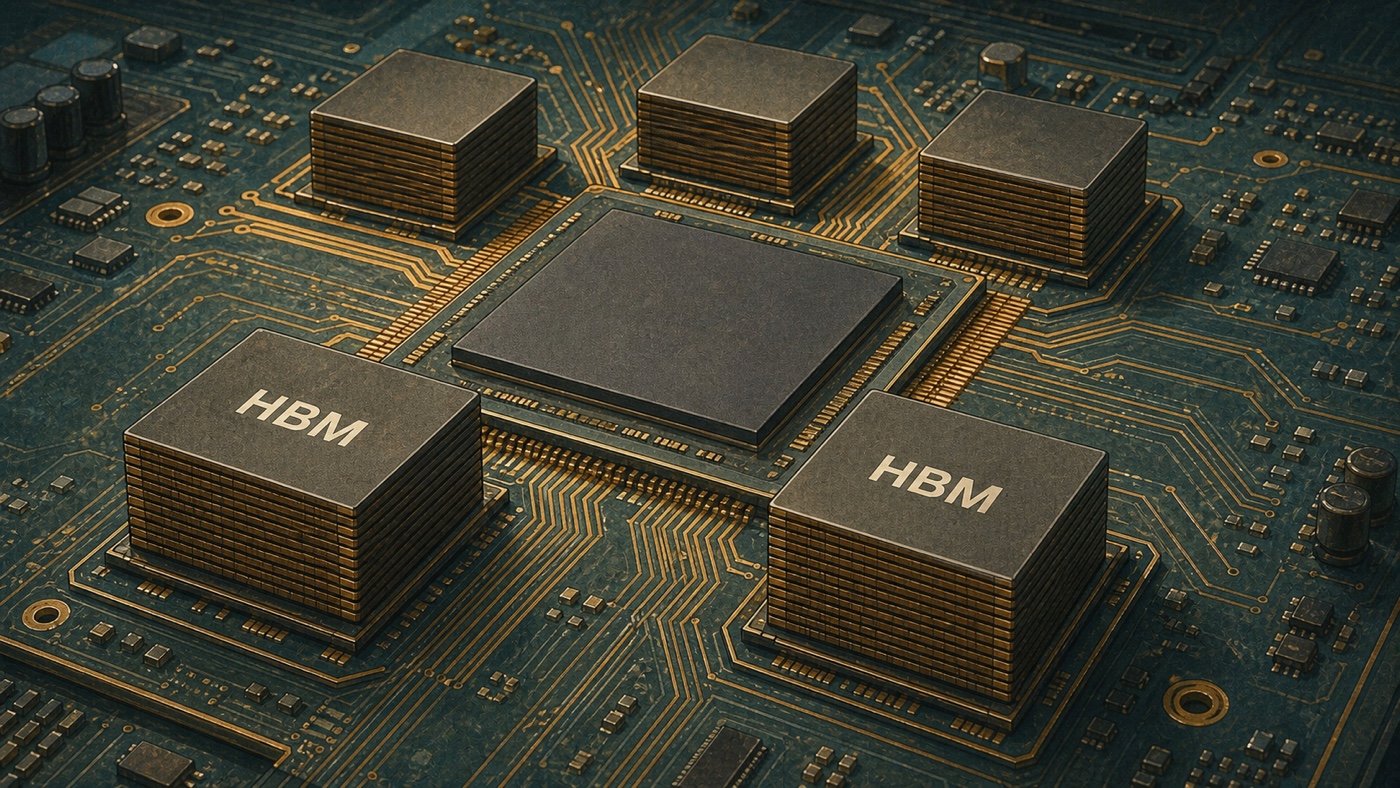
High-bandwidth memory (HBM) is stacked DRAM placed beside an accelerator. Its value lies in moving enormous volumes of data without starving the GPU or custom AI chip. HBM requires leading-edge DRAM, advanced packaging, thermal management, a logic base die, and lengthy qualification with a small number of accelerator customers. A failed stack can waste expensive silicon around it. Yield and reliability matter as much as raw bit output.
Conventional server DRAM holds the working state of CPUs and accelerators. It is less exotic, but AI servers carry far more memory than traditional machines. It also benefits indirectly from HBM: every wafer and clean-room bay directed toward complex HBM is capacity not used for ordinary DRAM.
NAND flash and enterprise SSDs sit farther from the processor. They store model weights, embeddings, retrieval indexes, training checkpoints, and the rapidly growing key-value caches created during inference. Enterprise products earn premiums for endurance, firmware, latency consistency, and power efficiency. Yet the underlying NAND bits remain more interchangeable and supply is relatively elastic once factories are running.
Nearline hard drives are the archive. They are too slow for an accelerator’s working memory but economically difficult to replace when hyperscalers need to retain exabytes. Seagate, Western Digital, and Toshiba supply high-capacity enterprise HDDs. Toshiba's MG11 series includes 24 TB conventional magnetic recording drives for cloud and data-center workloads. The market is concentrated, but it is not a two-supplier market. Higher areal density lowers cost and power per terabyte, giving hard drives a durable role beneath flash.

HBM is a bottleneck, not a permanent monopoly
HBM deserves the highest-quality multiple in the group today. Its demand is tied to the number and memory content of accelerators, not merely to replacement PCs. Each generation is harder to manufacture. HBM4 doubles the interface to 2,048 data pins, adds a sophisticated base die, and integrates more deeply with the customer’s system design. Suppliers cannot redirect commodity inventory and call it qualified HBM.
The market therefore rewards execution. Micron is shipping HBM4 in volume for its lead customer and expects HBM4E production in 2027. Samsung began commercial HBM4 shipments in February and expects its HBM revenue to more than triple this year. SK hynix entered the cycle with the strongest HBM franchise and continues to sell high-value memory into AI systems.
This is a genuine moat, but it is a moving one. Product leadership must be won again at every generation. Qualification is concentrated among a few enormous buyers with the engineering staff and purchasing power to encourage a second or third source. Packaging partners can add capacity. Yields improve. Samsung’s return as a credible HBM4 supplier is good for the ecosystem and potentially bad for scarcity rents.
Most important, HBM consumes capital. Micron expects roughly $27 billion of capital spending in fiscal 2026, with quarterly spending rising again in 2027 as it pulls forward clean-room construction. That expansion will not produce finished supply immediately; fabs take years and HBM packaging remains complex. An 86% gross margin gives suppliers a strong incentive to pursue that expansion.
The bear case does not require AI demand to collapse. Supply only needs to grow a little faster than customers’ urgent requirements, or accelerator makers need to pause between architectures. In a fixed-cost industry, the marginal few points decide the price.
Ordinary DRAM may be the most misunderstood winner
HBM attracts the headlines, but conventional DRAM explains why the current cycle has spread across phones, PCs, automobiles, and industrial products.
In Micron’s latest quarter, DRAM bit shipments rose only in the low single digits sequentially while average prices increased in the low-60-percent range. That distinction is crucial. Revenue growth came overwhelmingly from price and mix, not a sudden flood of physical bits. Samsung likewise attributed record memory earnings partly to higher average selling prices and limited supply.
AI creates direct demand through memory-heavy servers and indirect scarcity by pulling advanced capacity into HBM. Meanwhile, the producers that survived the last downturn have become more cautious about adding commodity output. Micron has signed 16 strategic customer agreements, generally running through 2030, that provide supply assurance and may make future revenue less exposed to the spot market.
That could represent a healthier industry structure. It does not repeal the cycle. Long-term agreements differ in pricing, volume commitments, remedies, and flexibility; “contracted” is not synonymous with “fixed high margin.” Node transitions also create more bits per wafer without a new building. Once fresh clean-room capacity arrives, ordinary DRAM lacks HBM’s packaging and qualification barriers.
Investors should separate bit growth from price growth every quarter. If unit economics are improving while bits remain constrained, earnings can stay exceptional. If bits accelerate just as average selling prices flatten, the profit peak may already be visible in the income statement.
NAND has the best demand story and the weakest memory
Enterprise flash has a compelling AI use case. Training creates checkpoints; inference creates retrieval indexes and caches; agentic systems repeatedly read large datasets. Micron has begun shipping a 245-terabyte QLC SSD. Sandisk’s data-center revenue rose 233% sequentially in its April quarter. These are not consumer USB drives being relabeled as AI.
But NAND has repeatedly punished investors who confuse a growing market with a good industry. Producers can stack more layers, improve bits per cell, and turn idle output back on. Customers can defer purchases when inventories rise. Qualification and firmware create a moat at the drive level, but a large part of the value remains sensitive to the price of NAND wafers.
Sandisk offers the clearest evidence. Its fiscal third-quarter revenue nearly doubled sequentially to $5.95 billion, helped by a richer data-center mix and higher pricing. Its 78.4% gross margin was 56 percentage points above the prior-year level, and management guided to 79% to 81% for the following quarter. The company has also signed multi-year arrangements with firm financial commitments, which may improve durability.
The bullish reading is that AI has reset the value of enterprise flash. The cautious reading is that no mass-produced storage medium retains an 80% gross margin unless supply is extraordinarily tight. Both can be true. A structurally larger market can still deliver violently cyclical earnings.
Hard drives: the quietest and perhaps cleanest case
The hard-drive thesis is less spectacular. It may be more legible.
After separating its flash business, Western Digital is a focused HDD company. Its fiscal third-quarter revenue rose 45% year over year to $3.34 billion and GAAP gross margin reached 50.2%. Seagate reported $3.11 billion of revenue and a 46.5% GAAP gross margin. Both are benefiting from hyperscale demand, disciplined supply, and higher-capacity drives.
AI strengthens “data gravity”: generated data may be processed in fast memory, but useful records, model artifacts, video, telemetry, and backups must live somewhere. Nearline HDD remains the cheapest practical home for much of it. Heat-assisted magnetic recording and other areal-density gains can raise capacity without equivalent growth in heads, media, power, or floor space.
The risk is that industry discipline is partly a product of consolidation and long qualification cycles, not immunity from substitution. Flash cost per bit continues to fall. Hyperscalers are a concentrated customer group. A delayed capacity transition can create shortages; a successful one can produce more exabytes than expected. And when a mature hardware company earns a 50% gross margin, the market may capitalize a scarcity period as if it were a new permanent baseline.
Is there a bubble?
There is no convincing evidence that AI memory demand itself is fictitious. Shipments, customer commitments, product qualifications, and cash flow are visible. This is not a pre-revenue theme assembled from investor slides.
There is, however, a classic bubble risk in the extrapolation.
WSTS expects the memory market to grow roughly 250% in 2026 and then 32% in 2027. Even the forecast embeds a dramatic deceleration. Micron’s latest DRAM price increase, Sandisk’s margin expansion, and the HDD makers’ record profitability all describe an industry operating far above its through-cycle economics. Stocks can fall while earnings rise if the rate of improvement merely becomes less extraordinary.
Trailing price-to-earnings ratios are particularly unhelpful near a cycle peak. The denominator is changing faster than the numerator. A producer can appear cheap on the quarter in which scarcity is greatest and expensive one year later without its share price moving. The better exercise is to normalize price, utilization, and margin across a full replacement cycle, then ask what portion of today’s demand and customer structure is genuinely new.
A disciplined investor should watch six things:
- bit shipments versus average selling prices: price-led growth is powerful but more reversible;
- capital spending and clean-room timing: today’s capex is tomorrow’s supply;
- inventory days at producers and customers: shortages often end before management language changes;
- HBM yield and customer qualification: leadership is valuable only while it remains hard to replicate;
- contract quality: duration matters less than enforceable volume, pricing, prepayments, and cancellation terms; and
- gross margin by product: a blended number can hide commodity exposure behind a small, premium category.
The investment conclusion
The memory boom is not one trade. HBM has the strongest near-term scarcity and the deepest technical barriers. Conventional DRAM has the largest indirect benefit from capacity diversion. Enterprise NAND has enormous AI volume potential but the most dangerous history of supply elasticity. Nearline HDD offers slower growth, a concentrated market, and a credible cost advantage for cold and warm data.
The highest-quality companies will use this windfall to improve technology, secure customer commitments, and return cash without assuming that today’s prices last forever. The weakest investment cases will require both perpetual AI demand acceleration and permanent scarcity margins.
AI has made memory availability a limit on system output. Suppliers can earn more while that constraint persists, but the same profits encourage new capacity and designs that use fewer scarce bits. Durable returns depend on qualification, manufacturing execution, and customer commitments after supply improves.
Sources
Corrected September 23, 2026: included Toshiba among enterprise HDD suppliers and replaced the broken Micron link with its official fiscal Q3 results release. The financial comparison retains the July 19, 2026 information set. The related HDD chart now describes manufacturing scale rather than a two-vendor market, with a stacked layout for smaller screens.
This report compares operating economics rather than recommending individual securities. Company claims are identified as such; financial figures are GAAP unless noted.