

Markets like technologies they can draw.
The internet had the globe. Cloud computing had the server rack. Artificial intelligence had the glowing chip. Physical AI has found an even better image: a machine with two arms, two legs, and just enough resemblance to us to make an entire economic future visible in one photograph.
That image will be powerful in the stock market. Humanoid robots combine nearly every ingredient of a durable investment theme: AI, labor scarcity, reshoring, demographics, falling hardware costs, national industrial policy, and a market that can be described in millions of potential workers. Public investors are also gaining their first relatively direct vehicle: Agility Robotics agreed in June to merge with Churchill Capital XI at a $2.5 billion pre-money valuation.
The commercial evidence is stronger than it was a year ago. Agility’s Digit has moved more than 100,000 totes in a live GXO warehouse and is deployed with manufacturing and logistics customers. Figure says it has built more than 350 third-generation robots and raised production from one per day to one per hour. Boston Dynamics has committed all of its 2026 Atlas deployments to Hyundai and Google DeepMind. Tesla is installing its first Optimus production lines. China is moving from demonstrations toward state-supported factory deployment at a speed no other country can match.
But a market theme can be directionally right and financially careless. A backflip is not uptime. An announced production line is not customer demand. A robot that replaces one repetitive motion is not a general-purpose worker. And the company that assembles the most human-looking machine may not capture most of the industry’s profit.
The next major theme is likely to be physical AI. Humanoids will be its face, but not necessarily its largest or safest pool of value.
What changed
Robots are not new. The International Federation of Robotics recorded 542,000 industrial robots installed in 2024, more than twice the number a decade earlier. Nearly 200,000 professional service robots were sold that year, led by transportation and logistics systems. Factories already use arms, cobots, machine vision, autonomous mobile robots, and specialized cells at enormous scale.
What changed is the possibility that robots can be trained rather than fully programmed.
Traditional automation is excellent when the environment is structured and the task repeats exactly. Engineers define coordinates, fixtures, safety zones, and error states. The system can then outperform a person in speed, precision, and reliability. It becomes expensive when the product, object, or route keeps changing.
Vision-language-action models offer a different path. A robot can interpret a scene, connect an instruction to physical motion, learn from human demonstrations, and reuse behavior across related tasks. Simulation and world models create synthetic training situations that would be slow, costly, or dangerous to collect in the real world. More capable edge computers can run these policies on the machine. Better torque sensors, motors, batteries, and control systems make the resulting motion useful.
NVIDIA’s strategy captures the breadth of the shift. Its robotics stack spans simulation, world models, training frameworks, edge compute, and safety rather than one robot body. At GTC 2026, the partner list included industrial incumbents, surgical-robot companies, construction systems, mobile manipulators, and humanoid startups. The common layer is a machine that can perceive, reason, and act in the physical world.
Humanoids benefit from all of this work. So does almost every other robot.
Why two legs can make economic sense
A humanoid is not the mechanically simplest solution to most tasks. It is a solution to the cost of changing the world around the robot.
Factories, warehouses, tools, shelves, ladders, doors, and work instructions were built around the dimensions and reach of the human body. A biped with two arms can, in principle, enter this installed environment without new conveyor systems, floor rails, fixtures, or building layouts. The same fleet could move totes this month, feed a production line next month, and perform inspection later through a software update and a different end effector.
That flexibility matters most in brownfield facilities with high product mix, labor shortages, and tasks that change too often to justify a custom cell. Automotive and electronics plants are natural proving grounds because they have both controlled environments and a long list of ergonomically unpleasant jobs. Warehouses add repetitive material movement and a clear hourly labor comparison.
The form factor becomes less persuasive when the environment can be redesigned. A wheeled mobile manipulator is more energy-efficient and stable on a flat warehouse floor. A fixed arm is faster and more precise at a machine. A conveyor does not need a foundation model to move a box. The humanoid must earn its mechanical complexity through versatility.
That is the central commercial test: not whether a humanoid can perform one task, but whether it can perform enough changing tasks to offset the cost of legs, balance, batteries, safety systems, and field service.
The evidence is finally real, but still narrow
The strongest current proof comes from Agility. Its transaction materials report 65,000 hours of operation across nine committed customer facilities and more than $300 million of multi-year Digit v5 orders. The company says the orders relate to 1,000 robots under a three-year robots-as-a-service agreement. That is materially different from a lab video.
It also requires careful reading. The order value is subject to contractual milestones, includes warrants that vest as robots are deployed, and is not current revenue. The 65,000 hours include commercial and operational experience across the program; they do not establish the economics of an autonomous, general-purpose fleet. Digit’s best documented live job is moving totes between autonomous mobile robots and a conveyor. It is a useful task, but a bounded one.
The unit economics are promising. Agility illustrates an $8,500 monthly RaaS price, or about $100,000 per year, against roughly $200,000 of fully burdened human labor across two ten-hour shifts. It estimates a five-year service life of about 31,000 working hours and potential annual customer savings near $100,000.
Those are management assumptions, not audited cohort results. They require 120 productive hours per week, successful autonomous charging, low intervention, and maintenance that does not erase the labor saving. Digit’s disclosed battery runtime is four hours. If a customer must keep a technician nearby, redesign the workflow, or accept lower throughput, the comparison changes quickly.
Other milestones show manufacturing progress more than customer return. Figure’s 350-plus robots can accelerate data collection and product iteration, but the company has not published a comparable field-economics history. Boston Dynamics is beginning product shipments after decades of research. Tesla’s filings say it is preparing for large-scale Optimus production, but do not yet isolate robot revenue, deployed units, or customer payback.
China adds scale and policy support. Government sources report 14,400 domestic humanoid shipments in 2025 and more than 140 manufacturers. The Ministry of Industry and Information Technology launched a 2026 program to place humanoid and embodied-intelligence products in real operating environments. Large output and a deep component supply chain can compress cost rapidly. They can also produce overcapacity before product-market fit, especially when procurement, subsidies, demonstrations, and commercial demand are difficult to separate.
The proof ladder investors should use
Humanoid companies are often valued against the size of the human labor market. That denominator is almost useless. A robot earns access to labor spend one workflow at a time.
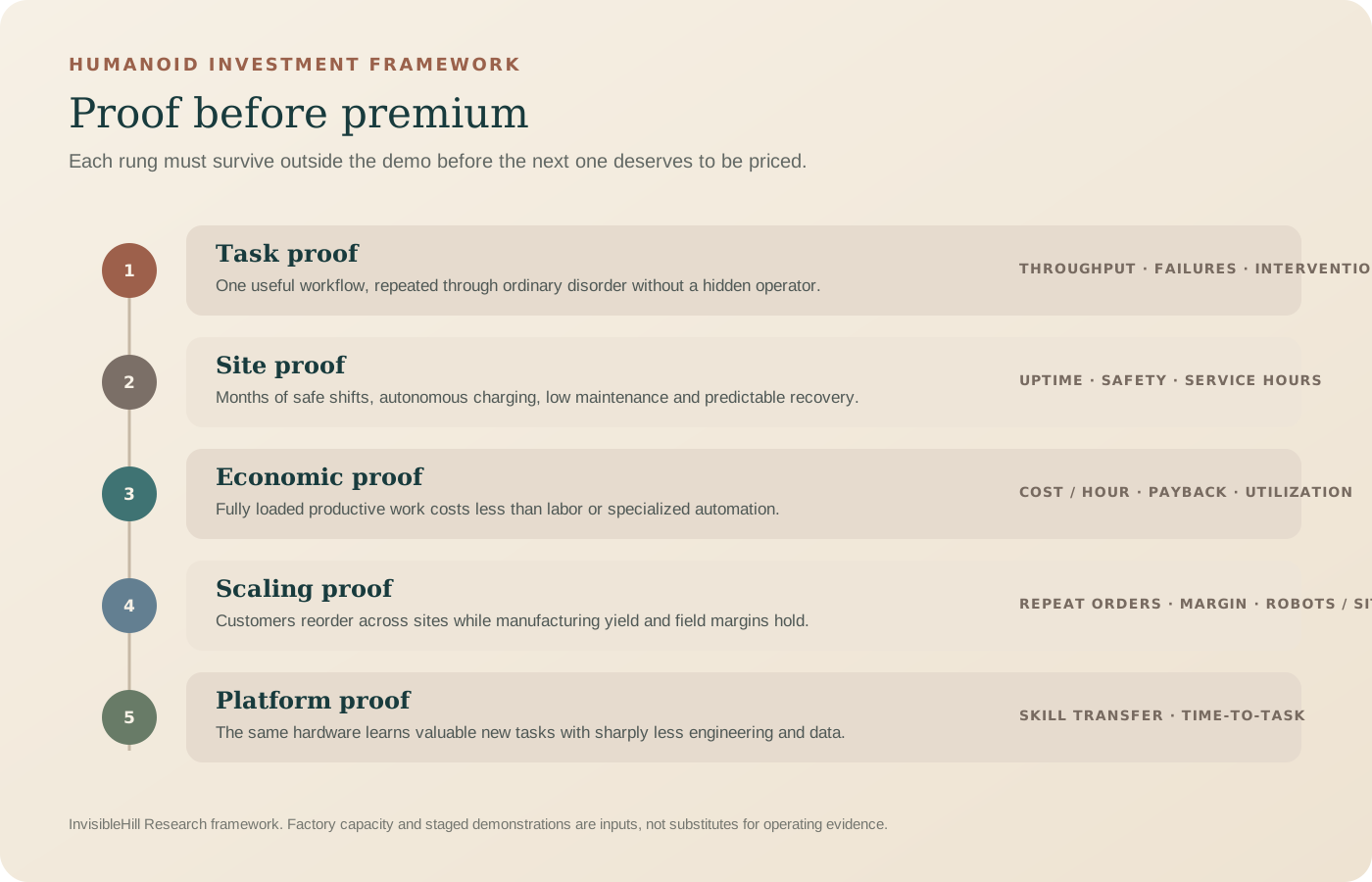
The first rung is task proof: throughput, success rate, human interventions, and recovery from ordinary disorder. A staged demo can conceal teleoperation, selected takes, friendly objects, or engineers just outside the frame.
The second is site proof: uptime over months, charging behavior, maintenance hours, safety incidents, and performance across shifts. Reliability compounds. A robot that is available 95 percent of the time loses more than one that is available 99 percent when several machines share a workflow.
The third is economic proof: fully loaded cost per productive hour after deployment engineering, spares, insurance, supervision, compute, and field service. Purchase price alone is a distraction. The customer buys reliable work.
The fourth is scaling proof: repeat orders without unusual incentives, deployment across multiple facilities, stable manufacturing yield, and gross margin after warranty and support. Capacity is not production; production is not deployment; deployment is not utilization.
The fifth is platform proof: new skills can be added with far less data, engineering, and downtime than a new automation cell. This is the rung that justifies comparing a humanoid to general labor rather than to a specialized machine. No company has demonstrated it at mass commercial scale.
Where the stock-market value may accrue
The public-market opportunity sits in four layers, each with a different risk.
Robot manufacturers capture the clearest narrative and the largest upside if their platform becomes a standard. They also carry inventory, warranty, deployment, safety, and field-service risk. Agility’s proposed listing creates a more direct U.S. pure play; UBTECH offers a listed Chinese exposure; Tesla and Hyundai carry meaningful programs inside much larger businesses. The challenge is attribution. A high valuation can price millions of future robots long before robotics contributes materially to consolidated cash flow.
Components include actuators, precision reducers, bearings, torque and vision sensors, hands, batteries, and thermal systems. This layer can benefit from many competing robot brands. It is not automatically a gold rush. OEMs are vertically integrating critical modules, Chinese suppliers are reducing prices, and the winning architecture may use fewer or different components. A supplier needs process know-how, yield, reliability, or certification, not merely a place on a speculative bill of materials.
Compute and software may be the broadest platform opportunity. Simulation, data generation, model training, edge inference, fleet orchestration, and safety tools apply across humanoids, autonomous vehicles, industrial arms, and mobile robots. NVIDIA is the obvious example, though robotics remains small relative to its data-center business. The investment case must not count a trillion-dollar addressable market as if every robot creates a data-center-sized revenue stream.
Incumbent automation and integration is less glamorous and closer to cash flow. Industrial robot makers, machine-vision companies, integrators, and warehouse-automation vendors already sell working systems. They can incorporate physical AI without betting the company on a biped. The risk is disruption if a general robot eventually replaces custom engineering; the opportunity is that customers usually need integration, safety validation, and workflow redesign regardless of the body.
The likely value chain is therefore not “humanoid OEMs win, old automation loses.” It is a long period of coexistence in which intelligence moves into every machine and humanoids expand the set of tasks that can be automated.
Why the theme can run before the industry is ready
Stock-market themes do not wait for mature income statements. They run on a credible change in slope, a small number of visible winners, and milestones that can be narrated quarter by quarter.
Humanoids now have those milestones: unit shipments, factory capacity, commercial agreements, live operating hours, safety certification, new skills, and falling bills of materials. The Agility transaction gives investors a price marker. Chinese production gives the industry a cost curve. Tesla gives it a large retail following. NVIDIA gives it an AI-infrastructure frame.
That makes humanoid robotics a plausible next hot trade. It also makes it vulnerable to the familiar sequence in which announced capacity is counted as sales, sales as recurring revenue, and recurring revenue as software margin.
Three developments would justify a durable re-rating:
- multiple customers expanding from pilots to fleets of hundreds without supplier financing or promotional warrants;
- independently reported cost per productive hour below the relevant labor or specialized-automation alternative; and
- safe operation near people while learning several economically useful tasks on the same hardware.
Three would break the story:
- intervention and maintenance remain high after the demonstration period;
- specialized robots keep winning on cost, speed, and reliability in the only tasks humanoids can perform; or
- price competition commoditizes the hardware before software and service revenue become defensible.
Home robots should be treated as a separate, longer-duration option. Houses are unstructured, users are untrained, objects are fragile, and the tolerance for a safety failure is near zero. IFR does not expect universal household helpers to reach mass adoption in the near or medium term. Industrial deployments can create valuable businesses without ever producing a robot that folds laundry.
The investment conclusion
Humanoid robots have crossed an important line. They are no longer only research objects, and a few deployments are beginning to produce the operating data, customer commitments, and unit-economics claims that a real industry needs. The market will be right to pay attention.
It will be wrong to treat a human-shaped body as the whole opportunity.
The deeper transition is from machines that repeat coordinates to machines that interpret environments and acquire skills. That transition will reach factory arms, autonomous mobile robots, surgical systems, vehicles, construction equipment, and inspection tools as well as bipeds. Some of the best returns may come from the software, sensors, integration, and safety layers shared across those forms. Some humanoid manufacturers will discover that the most expensive part of a robot is not the actuator. It is the last percentage point of reliable, unsupervised work.
Humanoids are likely to become a stock-market hotspot. Physical AI is more likely to become the industry.
Sources
This report evaluates an emerging industry rather than recommending individual securities. Company projections and “committed order” figures are identified as management claims and are not treated as recognized revenue. Evidence is current through July 19, 2026.
- International Federation of Robotics, World Robotics 2025
- International Federation of Robotics, “Humanoid Robots: Vision and Reality”
- Agility Robotics / Churchill Capital XI investor presentation, filed with the SEC
- Figure, 2026 production update
- Boston Dynamics, product Atlas announcement
- Tesla, first-quarter 2026 shareholder update
- China Ministry of Industry and Information Technology, 2026 real-world humanoid deployment program