
What is the difference between CPO and LPO?
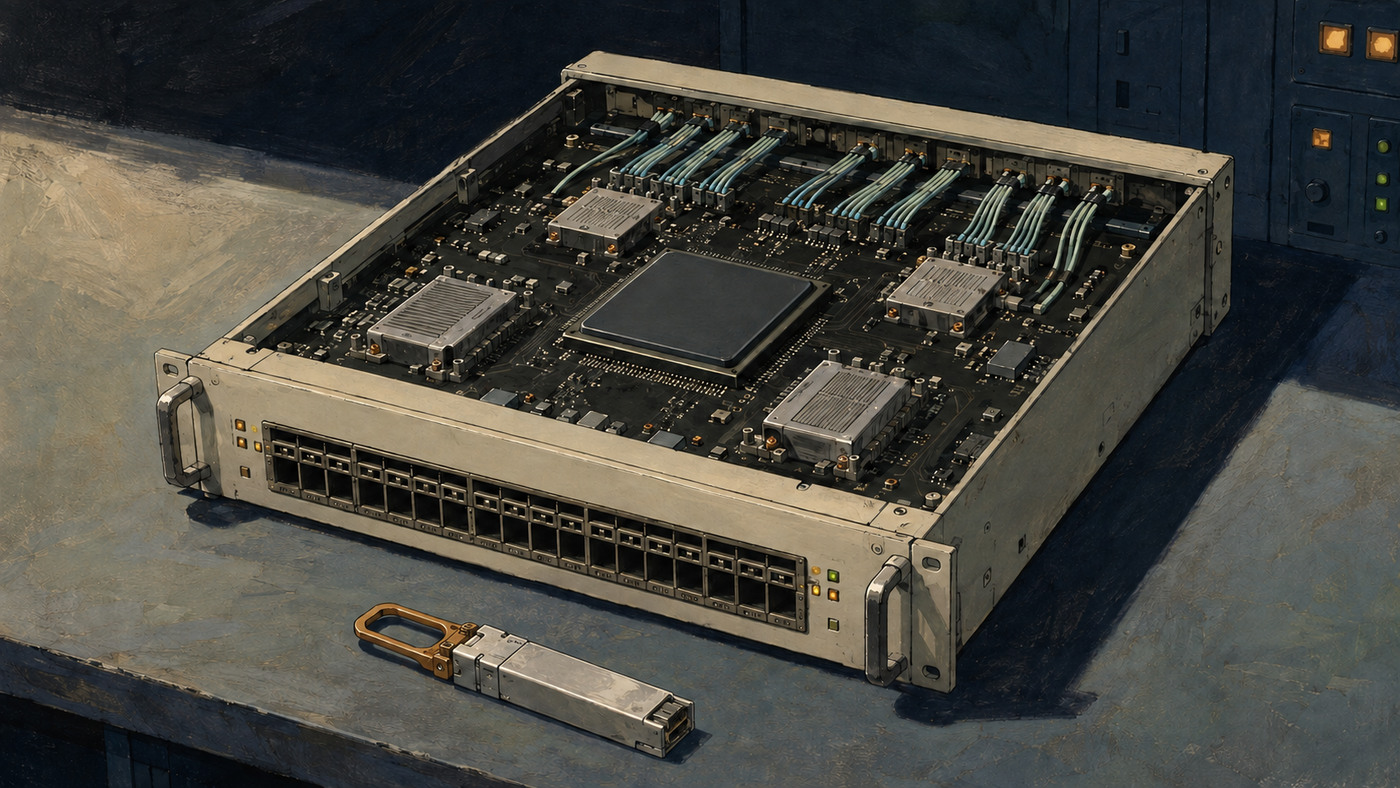
Co-packaged optics (CPO) puts optical engines beside the switch processor on a common package. Linear pluggable optics (LPO) keeps removable optical modules at the front panel but removes their digital signal processor, or DSP. Both can cut the electricity used to move data. CPO also shortens the electrical path to the optics; LPO preserves the ability to replace an individual module.
Our judgment is that qualified LPO deserves to be the cost baseline wherever it meets the required link performance. CPO earns a premium when its additional power savings, port density, or demonstrated operating reliability exceed the costs of adopting and maintaining the integrated system. Comparing CPO only with older, fully retimed modules can make that premium look easier to recover than it is.
The terms describe different design choices. CPO concerns packaging and placement. LPO concerns a linear signal path in a pluggable format. Silicon photonics is a technology that can appear in either. Treating every silicon-photonics product as CPO, or every pluggable module as LPO, confuses the comparison before any cost calculation begins.
Three architectures belong in the comparison
A conventional retimed optical module uses a DSP to process and restore the signal. LPO relies more heavily on the host chip's transmitters, receivers, and equalization. The LPO MSA's technical FAQ makes the resulting requirement explicit: the system needs a capable ASIC and carefully designed electrical transmission lines.
The table describes architecture, not universal performance rankings. A product still needs qualification at the intended speed, fiber reach, temperature, and error-rate target.
| Architecture | Optical placement | Signal processing | Maintenance unit |
|---|---|---|---|
| Retimed pluggable | Front-panel module | DSP/retimer inside module | Individual module |
| LPO | Front-panel module | No module DSP; greater reliance on host equalization | Individual module on a compatible host |
| CPO | Optical engines beside switch silicon | Short electrical channel; implementation varies | Product-specific optical engine, assembly, or system; lasers may be separately replaceable |
A module that fits a socket is not automatically compatible with its electrical channel. The MSA distinguishes compliant LPO links from engineered connections between LPO and retimed modules. A buyer needs evidence for the actual switch, module, and link combination.
The published numbers answer different questions
LPO has progressed beyond a proposed shortcut. In March 2025, the MSA released its 100 Gb/s-per-lane specification, covering parallel single-mode Ethernet links through 800 Gb/s. It reported interoperability testing across member products. Arista's June 2026 7060XE7 product brief lists LPO, linear receive optics (LRO), and fully retimed optics among its connectivity options. That is evidence that equipment suppliers are supporting several approaches, not a guarantee that every module works at every advertised port speed.
NVIDIA's January 2026 Spectrum-X Ethernet Photonics description reports a fivefold reduction in power per 1.6 Tb/s port relative to pluggable interconnects. It separately reports five times longer link-flap-free AI uptime against off-the-shelf Ethernet. Those are NVIDIA's product-level comparisons. Neither establishes a fivefold advantage over every qualified LPO deployment, and neither can be read as a fivefold reduction in the electricity bill for an entire AI facility.
A fair comparison needs equal delivered bandwidth, reach, lane configuration, and link quality. It must include external laser power and any change in host-side power, cooling, or supporting electronics. A low optical-engine wattage that leaves its laser outside the measurement boundary will understate system consumption.
The procurement comparison should also hold traffic and availability requirements constant. One vendor may quote a module maximum while another quotes a typical operating point. Dividing those figures produces an impressive ratio with little purchasing value.
How much can electricity savings pay for?
Consider an illustrative network with 100,000 populated 800 Gb/s optical endpoints, equivalent to 50,000 two-ended links. Assume every counted endpoint is eligible for either design, and CPO saves a net 3 watts of IT power per endpoint against a qualified LPO alternative. That saving includes any change in external-laser and host-electronics power; facility cooling enters separately below. This is a sensitivity assumption, not a measured specification for either technology.
Assume continuous operation, a four-year service life, electricity at $0.10 per kilowatt-hour, and a facility-power multiplier of 1.2. That multiplier approximates cooling and other overhead attributable to the saved IT power; an operator should substitute its marginal facility response rather than mechanically apply annual average PUE.
The model assumes the 3 W difference persists for every powered hour. The annual electricity saving is:
100,000 × 3 W ÷ 1,000 × 8,760 hours × 1.2 × $0.10 = $315,360.
Over four years, the undiscounted saving is $1,261,440, or $12.61 per endpoint. Counting both endpoints again would double-count the links. Discounting future savings would reduce their present value.
This yields an electricity-only ceiling on the extra upfront system cost per endpoint. The following figures are original scenario calculations, with all assumptions above held constant except the net power saving and electricity price.
| Net saving per endpoint | $0.10/kWh | $0.20/kWh | $0.30/kWh |
|---|---|---|---|
| 3 W | $12.61 | $25.23 | $37.84 |
| 6 W | $25.23 | $50.46 | $75.69 |
| 10 W | $42.05 | $84.10 | $126.14 |
These amounts are four-year electricity savings per endpoint, not market prices or total-cost estimates. Within this model, doubling the verified net wattage reduction or electricity tariff doubles the savings. Shorter service life and lower powered hours reduce them.
Suppose a CPO system carries a hypothetical premium of $50 per endpoint over the LPO system, including installation and required supporting equipment. The 3 W, $0.10/kWh case leaves $37.39 per endpoint unrecovered by electricity savings. Across this network, about $3.74 million must come from other benefits over four years. Any additional maintenance expense makes that requirement larger. If CPO instead has a lower acquisition cost, no electricity payback is needed to justify a purchase-price premium.
Avoided switching equipment or recovered compute time could cover that gap. The buyer needs a topology plan or operating record that supports the claimed benefit.
Reliability depends on repair scope as well as failure frequency
With pluggable optics, technicians can replace a module without replacing the switch processor. The operator still has many separate components to monitor and stock. Integration can remove electrical interfaces and failure opportunities while increasing the scope of some repairs. Neither architecture wins solely because of its component count.
CPO does not mean every failure requires discarding an entire switch. In its May 2025 CPO announcement, Broadcom described detachable fiber connectors and partner production of pluggable laser-source cages and connectors. Optical-engine faults, laser faults, and contaminated connectors can therefore have different recovery procedures. Those procedures must be checked against the offered system, rather than inferred from the CPO label.
An economic estimate should multiply the expected frequency of each incident by its actual repair and workload cost. That includes diagnosis, replacement labor, spares, and the compute time lost after redundancy and checkpointing have done their work. A failed port does not necessarily halt the entire cluster. A quick module swap can still disrupt a poorly protected job.
For the $50-premium scenario, suppose maintenance costs are otherwise equal. Spreading the roughly $3.74 million remaining premium over four years gives a recovery target of about $935,000 annually. At an assumed $100,000 of economic loss per equivalent cluster-wide lost hour, the system would need to prevent about 9.35 such hours a year. This is a break-even requirement, not an estimate of either platform's failure rate.
A purchasing team should ask for field incident rates, repair times, affected capacity, and the resulting useful accelerator hours. A vendor's link-uptime ratio cannot supply all four inputs.
Network density can outweigh the power bill
CPO's stronger economic case may come from a network that needs fewer switches or fits within a constrained facility. Higher radix, meaning more ports per switch, can change the number of network tiers needed for a given cluster. Whether it does so depends on the full topology and bandwidth requirements.
A denser switch can be valuable even if its optics save only a few watts. But a package-level advance does not guarantee that a particular deployment loses a switching tier. If the proposed CPO and LPO networks have different oversubscription, redundancy, or delivered bandwidth, their costs are not directly comparable. The value of an avoided switch should include its optics and operating costs without counting the same power reduction twice.
Pluggable optics are also evolving. Arista's XPO white paper describes a 12.8 Tb/s pluggable module and a design supporting 204.8 Tb/s of switching capacity in one Open Rack Unit. Its argument centers on density with field replacement and incremental deployment. XPO describes a different module form factor; it is not another name for LPO. The published design does not establish fleet economics. CPO bids should therefore face current pluggable designs as well as conventional modules.
In a facility with limited power, saved watts may support additional compute. That benefit has value only if the operator can install and sell the extra capacity. It should not be counted automatically on top of electricity savings for the same power: using the released capacity can keep the facility's bill unchanged while increasing output.
Where suppliers can earn the value
Investors need to trace which components survive the redesign. A customer can save money because a component disappears or its function moves into hardware the customer already owns. The supplier of the removed component may lose revenue even as network traffic grows.
LPO removes the module DSP from the design. Its adoption therefore puts the associated DSP content at risk while preserving demand for the host chip, lasers, analog electronics, connectors, and module assembly. The financial result depends on how much of that content a supplier owns and how much lower module prices expand unit demand. An optics supplier can sell more bandwidth while earning less revenue per bit.
CPO shifts more integration work toward the switch package. Broadcom's partner disclosures identify activity in fiber and connector production, sockets, laser-source interfaces, and complete switches. The disclosed work identifies where orders can appear, but a design win still needs acceptable manufacturing yield and repeat orders before it supports a profit forecast.
Warranty obligations and expensive replacement inventory can absorb margins that look attractive at shipment. Buyers with several qualified sources may negotiate away part of the engineering benefit. The relevant financial evidence is contribution margin after qualification, manufacturing losses, and support costs, together with the capital needed to deliver it.
This follows the same investment discipline as our analysis of AI memory scarcity: a required component can attract enough capacity and competition to erode its pricing power. Network improvements also affect the cost of serving AI models, but model providers may pass those savings to customers.
Which architecture should a buyer choose?
A buyer with a qualified LPO solution, adequate port density, and established repair operations has a defensible baseline. Paying more for CPO requires either a verified power saving large enough to recover the premium or a measurable improvement elsewhere in the network.
CPO becomes more compelling when electrical-channel limits constrain bandwidth, when density removes equipment or releases scarce space, or when field results show lower workload loss after repair consequences are included. A buyer should still compare against the best qualified pluggable alternative available for the intended deployment, rather than against an obsolete module.
A bid comparison should include acquisition cost, measured full-link power, and four years of expected repair and workload losses, using the workload and topology the buyer plans to run. If a supplier cannot document enough savings to recover its premium, the buyer has a financial reason to keep the qualified LPO design.
Sources
- LPO MSA: Technical FAQ and compatibility requirements
- LPO MSA: Release of the 100 Gb/s-per-lane specification, March 2025
- NVIDIA: Spectrum-X Ethernet Photonics architecture and claimed performance
- Arista: 7060XE7 product brief, June 2026
- Broadcom: CPO products and partner milestones, May 2025
- Arista: XPO white paper
The cost tables and break-even calculations are InvisibleHill Research scenarios. Their power, electricity-price, service-life, and outage-cost inputs are assumptions. They are not vendor quotations, independent hardware benchmarks, or measured failure rates.