
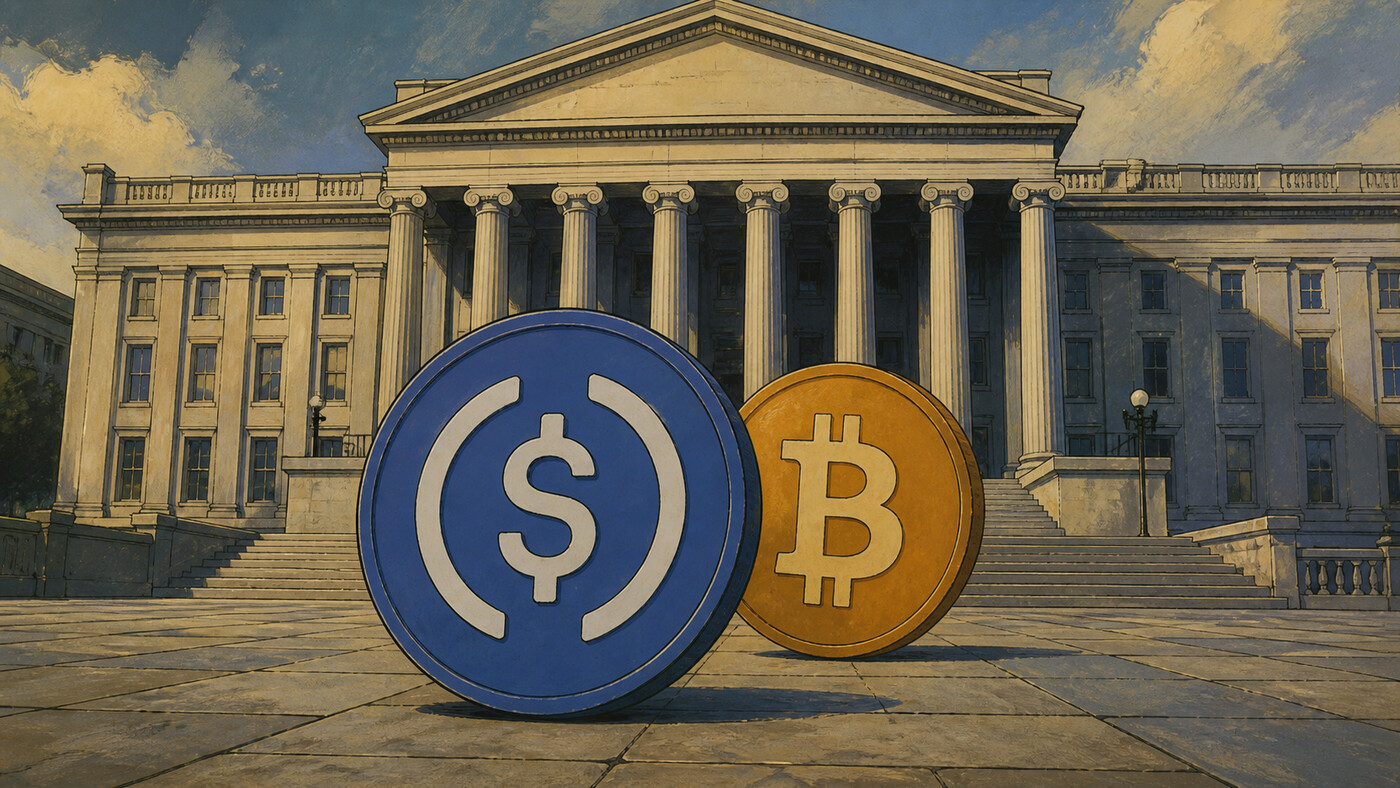
Two policies became one debt story
The phrase "Bitcoin debt strategy" bundles together an asset policy and a funding policy. Bitcoin would sit on the government's balance sheet. Dollar stablecoins affect the market for Treasury bills.
President Donald Trump's March 2025 executive order created a Strategic Bitcoin Reserve from bitcoin already owned by the federal government through completed forfeitures. Bitcoin placed in the reserve is not to be sold. The order also allows the Treasury and Commerce departments to develop additional acquisition strategies, but only if they are budget neutral and impose no incremental cost on taxpayers.
That is a reserve policy, not a debt retirement program. The more ambitious debt claim comes from the BITCOIN Act of 2025. The bill would require the Treasury to acquire 200,000 bitcoin a year for five years, hold the resulting one million bitcoin for at least 20 years, and then consider gradual sales for the sole purpose of reducing the national debt. On August 19, 2026, the bill remained at the introduced stage. Its latest listed action was referral to the Senate Banking Committee on March 11, 2025.
Discussion of the reserve often imports terms from the much larger bill. The executive order does not authorize the one-million-bitcoin purchase program.
A reserve asset does not cancel a liability
Federal debt is a liability of the government. Bitcoin held by the Treasury would be an asset. If bitcoin appreciates, the government's net financial position improves on paper. The face value of outstanding Treasury securities does not fall with it.
Debt declines only after the government obtains cash and uses that cash to redeem, repurchase, or avoid issuing Treasury securities. For a bitcoin reserve to reduce debt, bitcoin must appreciate, a future government must authorize a sale, and the market must absorb the position near the valuation used in the argument. None of those conditions is guaranteed. A quoted market price describes the last unit traded, not the price available for liquidating a sovereign reserve. The larger the sale, the less credible it is to multiply the full reserve by the screen price and call the result available cash.
The two purposes also pull in opposite directions. The executive order describes bitcoin as a reserve asset that should not be sold. The proposed legislation allows debt reduction only after a 20-year minimum holding period and advises against selling more than 10% of the reserve in any two-year period. The reserve case depends on patient ownership, while the debt case eventually requires liquidation.
One million bitcoin does not close the gap
Treasury data put total public debt at $39.99 trillion on August 17, 2026. Of that amount, $32.23 trillion was held by the public and $7.76 trillion was held within government accounts. The first measure matters most for capital markets. The larger figure is the familiar national debt total.
The proposed one million bitcoin reserve produces the following comparison:
| Assumed bitcoin price | Reserve value | Share of current total public debt |
|---|---|---|
| $100,000 | $100 billion | 0.25% |
| $1 million | $1 trillion | 2.50% |
| $10 million | $10 trillion | 25.01% |
| $39.99 million | $39.99 trillion | 100.00% |
The final row is a break-even identity, not a forecast. It also assumes that all one million coins could be sold at the same price without moving the market. Under the bill's suggested release limit, only 100,000 bitcoin could be sold in a two-year period. At $1 million per coin, that would raise $100 billion, equal to about 0.25% of today's total public debt.
The comparison gets harder over a 20-year holding period. The Congressional Budget Office projects a $1.9 trillion federal deficit in 2026 and average annual deficits of $2.4 trillion from 2027 through 2036 under current law. It projects gross federal debt of $64 trillion by the end of 2036. The first bitcoin acquired under the bill could not be sold until well after that forecast horizon.
Bitcoin could produce a large fiscal windfall. The numbers do not support treating that windfall as a substitute for fiscal policy.
Budget neutral does not mean costless
The executive order restricts additional bitcoin acquisitions to strategies described as budget neutral. The BITCOIN Act proposes two funding channels. It would redirect certain Federal Reserve remittances, when available, and revalue Treasury gold certificates from their statutory price to the market value of the underlying gold. The Federal Reserve would remit the difference to the Treasury. Funds needed for the bitcoin purchases would receive priority, with any excess directed toward public debt.
This structure can avoid a conventional appropriation while leaving the economic trade-off intact. A dollar transferred to buy bitcoin cannot also retire debt, cover spending, or remain available for another public purpose. Revaluing an existing asset changes the accounting capacity of the Treasury and Federal Reserve. It does not create an external payer for federal obligations.
The consolidated public balance sheet would exchange one asset or claim for another. Taxpayers would gain if bitcoin later outperformed the alternative use of those resources. They would lose relative to that alternative if it underperformed. Calling the acquisition budget neutral describes the route used to fund it. It does not settle the investment case.
Stablecoins connect directly to Treasury demand
Stablecoins operate through a different mechanism. The GENIUS Act requires permitted payment stablecoins to maintain identifiable reserves on at least a one-to-one basis. Eligible reserves include U.S. currency, demand deposits, Treasury securities with no more than 93 days remaining, overnight repurchase agreements backed by short-term Treasuries, and government money market funds invested in the same asset set.
When a user exchanges a dollar for a stablecoin, the issuer can place the reserve dollar into a Treasury bill. The user receives a transferable digital dollar. The issuer receives the interest income, subject to its costs and obligations. The Treasury receives another potential buyer for short-term debt.
No token price increase is required. Demand can grow with payments, dollar savings outside the banking system, and stablecoin settlement. A person outside the United States can acquire a dollar claim that may be backed by a Treasury bill without opening a U.S. brokerage account or purchasing the bill directly.
That makes stablecoins more relevant to debt financing than bitcoin. They can broaden the distribution channel for Treasury bills. They still do not reduce the amount owed.
New buyers depend on where the dollars came from
The Treasury Borrowing Advisory Committee identified the central limitation in May 2025. Stablecoin growth creates new Treasury demand only when the money comes from somewhere that was not already financing the government.
Funds from users who previously held no dollar assets can add to demand for Treasury bills. Funds moved out of a government money market fund may change the wrapper while leaving Treasury demand roughly unchanged. Funds moved out of bank deposits can have mixed effects because banks also hold Treasuries and use deposits to create credit.
The source of funds matters as much as the size of the stablecoin market. A $1 trillion increase in stablecoins could recycle money from existing holders of bills, repos, or money market funds rather than add the same amount of Treasury demand.
Stablecoins also concentrate demand at the short end of the curve. Their reserves must remain liquid enough to meet redemptions, so they favor bills and overnight instruments rather than ten-year or thirty-year debt. That can lower financing pressure for short maturities while doing less for the long-term securities that carry duration and refinancing risk.
Stablecoins can improve market access and perhaps lower the marginal cost of some borrowing. Persistent primary deficits would remain.
Financing capacity is not debt sustainability
The United States must find buyers for a growing stock of Treasury securities while deciding why that stock keeps growing. Crypto policy can affect the buyer base. It has little direct effect on the deficits that create the debt.
A strategic bitcoin reserve would expose the government to an asset whose gains could be very large and whose value can also fall sharply. A gain would improve the government's balance sheet, but debt reduction still depends on an eventual sale. Regulated dollar stablecoins have a more direct connection to Treasury demand. Their effect depends on adoption, reserve composition, and whether users bring genuinely new dollars into the market.
Neither mechanism changes the spending and revenue paths that produce annual deficits. Lower borrowing costs can even reduce the immediate pressure for fiscal adjustment while allowing more debt to accumulate. That may be a rational financing objective, but it should not be described as deleveraging.
Bitcoin gives the Treasury a long-dated exposure to a scarce asset. Stablecoins can widen global distribution of short-term dollar debt, which is more useful for financing than for deleveraging. Taxes, spending, economic growth, inflation, and federal borrowing costs will still set the debt path.
Sources
Debt figures use the Treasury observation published on August 17, 2026.
- White House executive order establishing the Strategic Bitcoin Reserve
- Congress.gov summary and status for the BITCOIN Act of 2025
- U.S. Treasury Fiscal Data, Debt to the Penny
- Congressional Budget Office, The Budget and Economic Outlook: 2026 to 2036
- GENIUS Act, current compiled text
- Treasury Borrowing Advisory Committee report on stablecoins and Treasury demand